Favorite Baby Camping Foods

  1. Share
0 0

Created in partnership with Morrison Outdoors.

Bringing your baby camping and enjoying the great outdoors together is a dream for a lot of parents. There is just something special about introducing your children to an activity you enjoyed before they were born or that you enjoyed as a child. And while camping with young children is not always easy, planning ahead always helps the experience run a bit smoother.

Favorite Baby Camping Foods

Being prepared when it comes to food is one of the easiest ways to help your camping experience turn out as you’ve dreamed of. Happy and well-fed babies, mean happy parents, right? These favorite baby camping foods and tips are perfect for newbie campers and seasoned damping pros. Note: If your baby takes a bottle or eats formula, make sure to bring clean drinking water to prep and cleaning.

Fruit/veggie squeeze pouches

Whether you make your own or buy them from the store, these pouches are an incredibly convenient food source to have on hand while camping. Not only are they easy to store and require no prep at the campsite, but they are also easy for babies to eat anywhere.

Sharing whatever you’re eating

Babies love trying the food mom and dad are enjoying, so make camping life easier by planning to feed them a bit of whatever you are planning to eat yourselves. Are you grilling corn over the fire, cooking up some eggs, or making a foil pocket meal? Depending on the age of your baby, you can mash up a bit of the food your baby has already had or just feed them small pieces of everything. Pro tip: Plan ahead to ensure you have one item per meal your baby will eat (or has already tried) is an easy way to make this option a success. This baby camping food is geared more toward the slightly older babies, since introducing new foods is not ideal while camping.
Fresh fruits and veggies

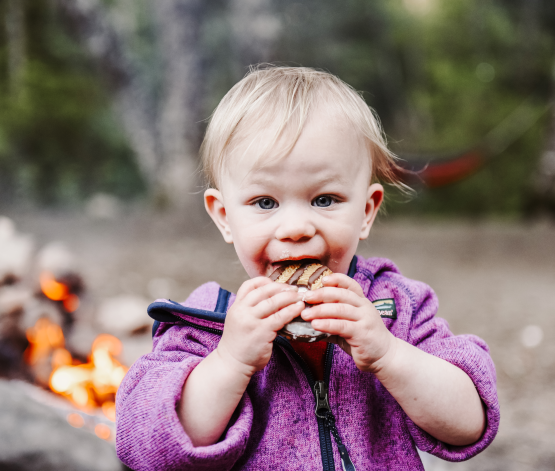
Most parents start feeding their babies fruits and veggies first, so most babies are accustomed to eating mashed or pureed fruits and veggies at home. Keeping mealtimes similar to at home can help ensure babies feel comfortable while they experience the sensations of camping. Easy to mash foods, such as bananas, avocados, berries, or cooked peas make prepping meals easy while camping. But many of these easily mashable foods are also a bit harder to store, so having a space to store them without accidentally squashing them is something you consider before you head out on your trip.

Finger foods

Babies love to feed themselves and if your baby is already accustomed to eating crackers, cheese sticks/pieces, bananas, and other finger foods, then bringing them along is the perfect option for camping too. Many of these can be prepped at home or are easy to prep right at the campsite, so they help make camping easier for everyone.

Camping foods for older kids

While you are enjoying your camping experience with baby, some of these other food ideas may be helpful for both you and older children if you have them. Not only are these camping food ideas easy, but they've been tested by other camping families and passed the child-friendly test.


What are your favorite foods to bring along for baby while camping?

OTHER ARTICLES IN THIS SERIES:

Photos by Deanna Curry.  

ABOUT OUTGROWN

OutGrown is a 501(c)(3) nonprofit that works to create a world where everyone can enjoy the physical and mental benefits of spending time outside. We are focused on creating opportunities and removing barriers to access so families with babies and young children can take their first steps outside. We believe all families have the right to connect with nature, benefit from spending time outdoors and be inspired to a lifelong love of nature. Since its grassroots inception in 2013, OutGrown is a growing community of 280,000 families and over 300 volunteer Branch Ambassadors. More information on all of our programs can be found at WeAreOutGrown.org 


EDITORS NOTE:

We hope you enjoyed reading this article from OutGrown. We’re working hard to provide our community with content and resources that inform, inspire, and entertain you.

But content is not free. It’s built on the hard work and dedication of writers, editors, and volunteers. We make an investment in developing premium content to make it easier for families with young children to connect with nature and each other. We do not ask this lightly, but if you can, please make a contribution and help us extend our reach.

Community tags

This content has 0 tags that match your profile.

Family Adventures

Comments

To view comments or leave a comment, login or sign up.

Related Content

0
Exploring Nature with Your Senses: Touch
Updated for 2025: Spring Sensory Celebration As we step into a new season, we’re refreshing this post with new insights and activities for our Spring Sensory Celebration! This annual initiative encourages families to slow down and experience nature with all five senses. Whether you’re a longtime follower of OutGrown or discovering us for the first time, we hope these ideas inspire fresh ways to explore the outdoors with your little ones. While wandering through nature, we take in our surroundings using our senses. We smell flowers, touch tree bark, listen to bird calls, see details (like an ant trail on a tree), and even taste some of the natural objects we come across (think berries or edible flowers). And, while investigating nature in this way comes naturally to most children, sometimes we forget to allow children the time and space they need to do it. As part of OutGrown’s Spring Sensory Celebration, we’re sharing simple, engaging ways to activate each of the five senses outdoors with young children. Photo Credit: Michelle Pearl Gee Exploring Nature by Touch Touch is one of our most immediate ways of experiencing the world. Every moment outside offers a chance to notice new textures and sensations, from the sun's warmth to the rough bark of a tree under our fingertips. Though we take almost all of our touch sensations for granted and do not think much about them, one minute outside can feel like this: You touch the doorknob to let yourself outside and immediately feel the warm air and a slight breeze on your skin. You step outside, and your bare feet feel the warm cement ground. You walk toward your front yard and brush your arm up against a bush. You touch some flowers right before your feet touch the cooler grass. You take a moment to relish the feeling of the grass before you sit down and feel the soft ground under your body and maybe a slight itchy feeling on your legs. We often take these sensations for granted, but when we slow down and focus, we can turn everyday outdoor moments into a mindful, sensory-rich experience. But, if we slow down outside, practice a little mindfulness, and think about each feeling as it touches our body, it can shift any outdoor experiences greatly. Five ways to slow down and experience the sense of touch in nature: Create a touch box. A touch box is a fun, hands-on guessing game that helps kids explore nature through feel alone. Gather natural objects, such as pinecones, feathers, and smooth stones, place them in a box, and have kids guess each item by touch. You gather some simple natural items and put them inside a box. Don’t let your children see what is in the box and have them guess what nature item it is based on touch alone. You can put one item in at a time (good for younger children) or all at once to make it more challenging. Walk barefoot in nature. Our feet are packed with nerve endings, making them perfect for sensory exploration. Walk barefoot on grass, sand, or dirt, noticing how each surface feels differently. When you intentionally think about each sensation your feet feel, the whole experience of walking barefoot shifts just a bit. Find different textures in nature. Try a texture scavenger hunt! Challenge kids to find something rough, smooth, soft, bumpy, cool, or warm. You can also just have the ideas in your head and have the kids search for one at a time while you meander your favorite trail. Some examples of easy-to-find nature textures are rough, smooth, cold, warm, wet, dry, hard, soft, etc. Hug a tree. Tree-hugging isn’t just for fun; it’s a great way to explore texture and size. Notice whether the bark is rough or smooth, warm or cool, thick or thin.. Are you able to wrap your hands all the way around? Is the bark rough or smooth? Count the skin sensations. Pause for a minute and count all the sensations on your skin, the breeze, the sun, and the feeling of the ground beneath you. You’ll be amazed at how much you notice when you focus! The wind on your skin, the sun's warmth, the feeling of the ground under your body, the fly that landed on your leg, and so much more. It is hard to focus on only the sense of touch, but how many different things our skin can feel in just one minute is fantastic. Ready to explore more? Join our Spring Sensory Celebration! Share your sensory nature experiences with us using #SpringSensory, and check out our other posts on hearing, taste, smell, and sight for more ways to engage with nature.   About OutGrown OutGrown is a national nonprofit working to ensure that every family, especially those with babies and young children, can experience the benefits of time outside. Since our grassroots beginning in 2013, we have supported more than 300,000 families with the help of thousands of volunteers across the country. We believe nature belongs to all of us from the very beginning. That means creating opportunities, removing barriers, and supporting families in finding their way outdoors, whether that starts with a stroller walk, a community outing, or a quiet moment under the sky. You can learn more and explore our programs at WeAreOutGrown.org. Editor’s Note Thank you for reading. At OutGrown, we believe content should offer more than information. It should create a connection, support real-life caregiving, and reflect how families grow together through nature. Everything we share is made with care by our team and volunteer community. If this piece inspired you or helped you feel more confident in your outdoor journey, we invite you to support our work by donating today. Your contributions help us keep resources free and accessible to all families. Please remember that the experiences and tips shared in this article are for general information only. They are not a substitute for professional medical, mental health, or safety advice. Always consult with a qualified provider if you have specific concerns or questions. We are glad you are here. We are growing something meaningful together.
0
Create an Outdoor Legacy for Your Children
“We must begin thinking like a river if we are to leave a legacy of beauty and life for future generations.” ― David Brower Summer is here. With that, the chance to make goals and opt to improve yourself and your family in some way.  Let’s collectively come together and choose to create an outdoor legacy for our children. That’s right. Let’s pass on some variation of going outside and enjoying nature. Let’s be the river and slowly carve out an appreciation and love of the great outdoors for our children. What is an Outdoor Legacy? Simply put, an outdoor legacy is an impression you instill in your children about the outdoors. It is the long lasting impact your actions surrounding the outdoors have on your children. It is how your children will approach the outdoors when they reach adulthood. Leaving this outdoor legacy behind doesn’t happen overnight. It is something you will continue to foster and develop throughout your child’s life. Even after your children are adults and long gone from your home, you can still actively engage your children in outdoor adventures that feed into the outdoor legacy you want to leave behind. Why Create an Outdoor Legacy? According to a 2004 study, 90% of adults participating in outdoor activities were first introduced to them between the ages of 5 and 18. In other words, exposing your children to the great outdoors during their childhood will likely result in their continued enjoyment of nature as adults. That's why at OutGrown we offer support and resources for families with babies to get outside. Knowing the earlier the exposure to nature, the higher the probability a child will connect with the outdoors and the benefits of time outside. And when only a mere 18% of adults and children spend time outside once a week and a solid 54% of individuals who currently do not participate in outdoor recreation are content to remain indoors, it is important to consider the impact we, as parents, have on our children in regards to getting outside. How to Create an Outdoor Legacy for Your Children Don’t worry, creating this outdoor legacy is not difficult and not nearly as daunting as it may seem. It is absolutely something you can ease into and still leave a beautiful and lasting outdoor legacy with your children. Here are some simple ways you can begin. Set an outdoor expectation for your family Invite your entire family to help you create an expectation for getting outside each week. Start off with an attainable goal that you can all hold yourselves accountable to and then once you consistently meet that goal, reevaluate it. And if you are like me, and set lofty goals, it is absolutely okay to lower your expectations of yourself and your family. Adjust the expectation to meet your family’s abilities. Getting outside is supposed to be fun and enjoyable. Don’t lose sight of that. Create outdoor focused traditions Outdoor traditions are another way that you can get your family outside and create lasting memories together. Here are just a few ideas, but there are so many traditions out there to choose from. Join Hike it Baby on New Year's Day for a First Day Hike Go for a hike in your holiday jammies and join the Holiday Jammies Hike Challenge (hosted by me on Instagram - @familyinwanderland Dress up in costumes and go for a hike, maybe add it in as part of your Halloween traditions. Give back to nature! Create a tradition of picking up trash once a month in a local park  Add an outdoor adventure into an already existing family gathering. Maybe start a tradition of going camping, fishing, or for a hike every year for your birthday. Walking or running a 5K as a family. If you don’t already, consider creating the tradition of an annual camping trip. You can absolutely rent a cabin or an RV, no need to sleep on the ground if that isn’t your cup of tea. But, the idea is to foster a love of the outdoors and camping absolutely allows you to soak in a ton of nature. Maybe your parents have an outdoor themed tradition you can renew. Something you remember doing as a child, but no longer do regularly? Bring it back and put your family’s own spin on it. Need more inspiration, try this post on outdoor holiday traditions. Take indoor activities outdoors Another way to spend more time outside and help pass on a love for the outdoors and create positive nature-related memories is to take your indoor activities outside. These are just a couple of examples, but just about anything can be done outdoors. Family read aloud in the backyard. Serve a meal outside picnic-style. Do homework on a blanket or outdoor table. Take indoor toys (legos, dress-up clothes, dinosaurs, etc.) outside for playtime. Make it fun and keep trying! Don’t forget to make it fun! Mix it up and do different activities outside. Host tea parties or themed hikes for some additional fun. And remember to keep trying. Often when we set goals for ourselves and our families, we tend to feel bad when those goals are not achieved. And if you are like me, when we feel bad, we start to get frustrated when our loved ones are not as into an adventure or activity as we want them to be. Don’t worry. If your last outdoor adventure was an epic failure (I’ve been there so many times), you can always try again another day. Repeatedly taking your children outside and continuing to share how to protect nature with them shows them it is important. They probably won’t remember the time they screamed at the top of their lungs for an entire quarter-mile on a busy trail or when they complained about all the roots on the trail. But, they will remember the general feeling that being outside gave them. They will remember the memories you create together and the amazing adventures and things they see. So be like a river and create the path for outdoor enjoyment for your children to follow. Create memories and develop skills. Create an outdoor legacy for your children. Some additional reading on this topic: 10 Ways to Get Your Kids Out of the House When Life Gets Busy 10 Tips to Raise the Next Generation of Adventurers in a High-Tech World How One Family Makes Getting Outdoors a Priority Learning in Nature: Programs that Promote Love for Nature ABOUT OUTGROWN OutGrown is a 501(c)(3) nonprofit that works to create a world where everyone can enjoy the physical and mental benefits of spending time outside. We are focused on creating opportunities and removing barriers to access so families with babies and young children can take their first steps outside. We believe all families have the right to connect with nature, benefit from spending time outdoors and be inspired to a lifelong love of nature. Since its grassroots inception in 2013, OutGrown is a growing community of 280,000 families and over 300 volunteer Branch Ambassadors. More information on all of our programs can be found at WeAreOutGrown.org    EDITORS NOTE: We hope you enjoyed reading this article from OutGrown. We’re working hard to provide our community with content and resources that inform, inspire, and entertain you. But content is not free. It’s built on the hard work and dedication of writers, editors, and volunteers. We make an investment in developing premium content to make it easier for families with young children to connect with nature and each other. We do not ask this lightly, but if you can, please make a contribution and help us extend our reach.