Keeping Your Family Warm on the Trail this Winter

  1. Share
Jen Grenter Jen Grenter
0 0

How to keep your family warm on trail in winter by Rebecca Hosley for Hike it Baby

As we head into winter and have the added challenge of trying to stay warm, one of the most common questions we get is, “How do I dress my family for outdoor adventures in the cold, and what other gear do we need?”  While the answer depends largely on where you live, we have compiled some helpful tips, gear suggestions and links to past blogs so that you have all the information you need for getting the most out of this winter in one convenient spot. "How do I dress my family for cold-weather outdoor adventures?" This is arguably one of the most asked questions throughout the year, and for good reason!  So let’s break it down based on age, because dressing an infant for the cold is very different from dressing a grown adult.

Adults

No matter the age, layers are key.

  1. Base layer: This is the layer closest to your skin. You may have heard the term “cotton is rotten,” which is never more true than picking a base layer for cold days in nature. Wool is generally best, but a synthetic blend of wicking material is a budget-friendly option as well. This layer comes in multiple varieties depending on temperature and activity level (heavyweight is the thickest for the most frigid weather conditions).
  2. Mid-layer: This layer goes over your base layer and keeps you warm (think fleece sweatshirt). I prefer a full-zip option to assist with chilly nursing sessions.
  3. 3rd layer: This is optional based on outdoor temperatures and your planned activity. When temperatures are very low or wind/snow are a factor, you may consider an extra layer to ensure warmth. Just remember, it is easy to take off a layer if you get warm, but you can’t add a layer you don’t have!
  4. Outer layer: Generally you will want a weather-resistant outer layer that can stand up to low temperatures along with possible precipitation and wind. How “weather-resistant” this layer needs to be will depend on the expected conditions. For example, if you are expecting rain or wet snow, you will definitely want a water-proof outer layer.
  5. Head, hands and feet: When temperatures are low, our bodies focus on keeping most of our warmth in toward our core to keep us safe. While this is essential, it can certainly get uncomfortable for our extremities! That’s why good-quality hats, gloves/mittens, socks, scarves, etc., are important. As with our body layers, it is best to stick with wicking wool or synthetic materials here as well.  Just remember, wet feet and hands will feel icy in low temperatures!
  6. Footwear: Traction and warmth are key, especially if you are babywearing or hiking on wet or icy terrain. If you live in a location that sees snow and rain, you will want waterproofing as well. Other than that, the type of footwear is largely personal preference here. For example, I prefer ankle support so I have traditional waterproof winter hiking boots along with snow boots. In contrast, my husband prefers a more flexible fit, so he sticks with waterproof trail runners unless more extreme conditions force him into his snow boots.

Check out these past blog posts for more in-depth information on winter layering, all-weather hiking essentials, and winter gear tips.

“Big-Kids” (aka older toddlers and beyond)

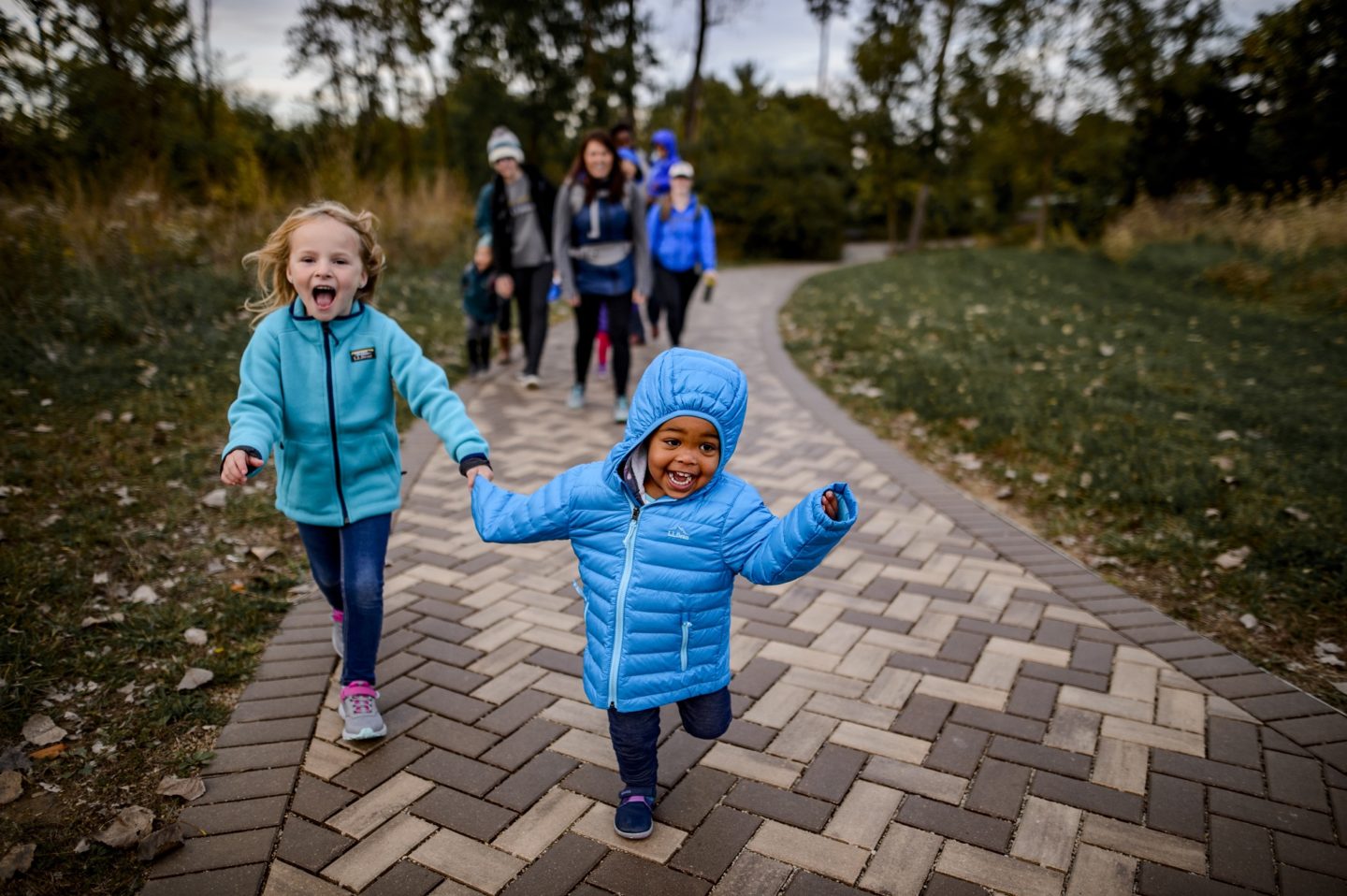
Children who are good walkers will follow much the same rules as adults with a few tweaks for kiddos who like to get down and dirty in the snow and mud.

  1. Full-coverage waterproofing: In order to stay warm, our kiddos need to stay dry. This isn’t always an easy task when snow or cold rain is involved. Consider either a waterproof winter coat and pants or a rain suit that can be used as a thin waterproof outer layer with multiple warm layers underneath.
  2. Waterproof boots and mittens/gloves: While adults can usually get away with water-resistant options, kids have a tendency to get as wet and messy as possible, so waterproof options are worth the extra money here. Check out some great options we can recommend here.

For more information on dressing the whole family for outdoor winter adventures, check out this article. How to keep your family warm on trail in winter by Rebecca Hosley for Hike it Baby
Infants

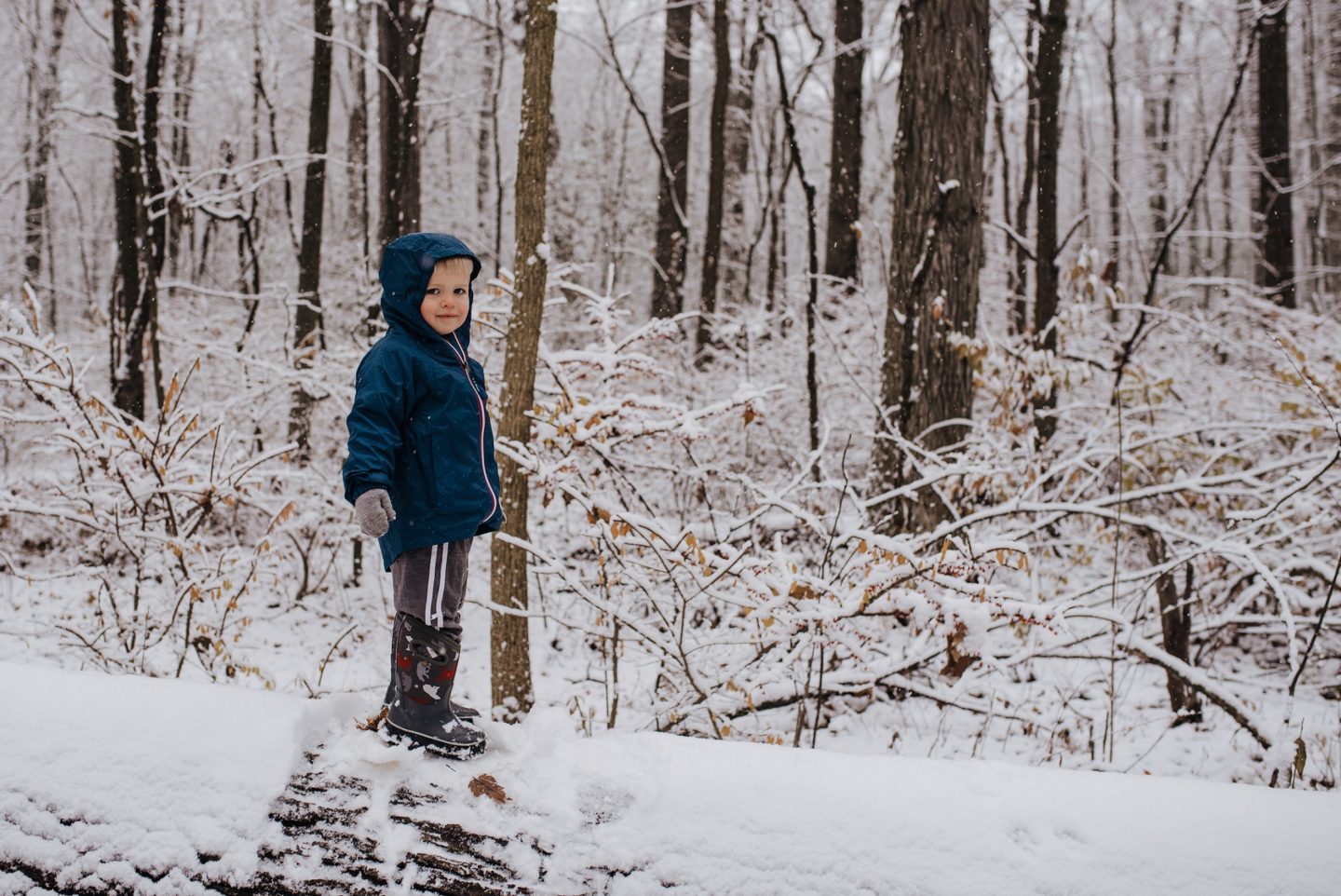
Dressing an infant for the cold will rely heavily on whether they are going to be in a carrier the majority of the time, crawling in or exploring the snow, or tucked away in a stroller. In general, layers are key. As with adults and big kids, start with a wool or synthetic base layer. Fleece-footed pajamas work well for a mid-layer, and a down or fleece bunting outer layer will help keep them warm and toasty. Add a warm hat that covers the ears and goes under the chin along with adult wool socks over their hands under the bunting to ensure these areas stay warm and dry. Include a waterproof outer layer (such as a rain suit or waterproof bunting) if they will be rolling in the snow.  For stroller walks, add a stroller weather-shield or a thick blanket for added warmth. Since infants are not great at regulating their own temperature, be sure to check for flushed skin, chilly extremities or irritability as signs that they may be too warm or cold. Find more information in these past blog posts on winter layering for infants and winter hiking with babies along with this past gear guide for more ideas on keeping your baby cozy in these colder months.

Babywearing to stay warm

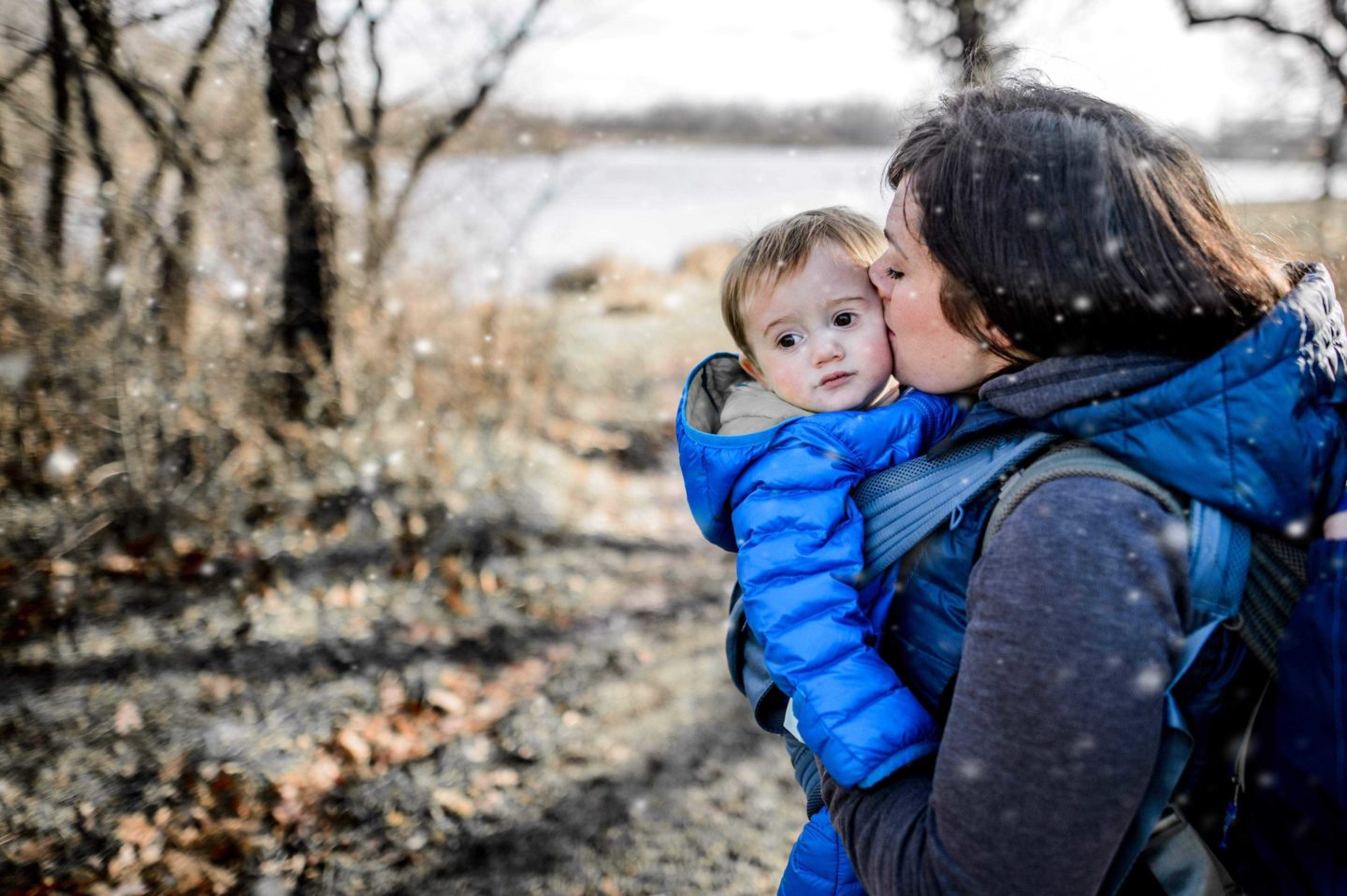
Wearing a baby (especially with a wrap or a soft-structured carrier) can get HOT. For this reason, you will need to consider how you layer both yourself and baby. For adults, removing the mid-layer (aka the “warm” layer) can help prevent over-heating. If you want more information on cold-weather babywearing, check out these articles on winter layering when babywearing, and layering for all aspects of motherhood (pregnancy on up). How to keep your family warm on trail in winter by Rebecca Hosley for Hike it Baby
What Other Gear do I Need?

This will differ based on trail conditions and outdoor activity, but here are some options to consider in order to make your adventure as enjoyable (and comfortable) as possible.

  1. Hiking essentials: Whether you are going on a family winter hike for a few hours or a longer snowshoeing adventure, be sure to pack the "10 Essentials" in a good-quality hiking pack. It’s a good idea to include some hand and foot warmers for those extra cold days! Read more about the 10 essentials and what you need for a successful day hike here.
  2. Traction cleats or spikes: Cleats or spikes are especially important when babywearing on frozen or snow-covered ground. They are easy to attach to most shoes and boots and help prevent slipping and sliding on the trails.
  3. Hiking poles: Hiking poles are another important gear option for added stability on icy or wet trails.
  4. Snowshoes: If you live in an area that experiences plenty of snowfall in the winter months, snowshoes are a fun (and at times more practical) option for hiking. They make them in toddler-/kid-size as well!  Check out this Family Snowshoeing 101 article for everything you need to know to get started with snowshoeing for the entire family.
  5. Sled or snow tube: Who doesn’t love speeding down a snowy hill?
  6. Winter camping gear: Are you ready to take the plunge and camp in the winter with your family?  While it may sound crazy, there are actually various benefits to cold-weather camping, such as less crowding and prime campsite availability. Check out a few of our past blog posts for tips on layering for cold camping and picking the right camping gear to ensure an enjoyable experience for the whole family.

What winter gear do you find essential to ensure an enjoyable outdoor experience for your family? Let us know in the comments below!

Read more:

Photos by Laura Castro and Amy Diebold.


ABOUT OUTGROWN

OutGrown is a 501(c)(3) nonprofit that works to create a world where everyone can enjoy the physical and mental benefits of spending time outside. We are focused on creating opportunities and removing barriers to access so families with babies and young children can take their first steps outside. We believe all families have the right to connect with nature, benefit from spending time outdoors and be inspired to a lifelong love of nature. Since its grassroots inception in 2013, OutGrown is a growing community of 280,000 families and over 300 volunteer Branch Ambassadors. More information on all of our programs can be found at WeAreOutGrown.org 


EDITORS NOTE:

We hope you enjoyed reading this article from OutGrown. We’re working hard to provide our community with content and resources that inform, inspire, and entertain you.

But content is not free. It’s built on the hard work and dedication of writers, editors, and volunteers. We make an investment in developing premium content to make it easier for families with young children to connect with nature and each other. We do not ask this lightly, but if you can, please make a contribution and help us extend our reach

Community tags

This content has 0 tags that match your profile.

Let's Talk Gear & Snacks

Comments

To view comments or leave a comment, login or sign up.

Related Content

0
Layering for Babywearing in the Winter
Created in partnership with our friends at  With so much focus on how to dress baby in the winter, we often forget that babywearing parents need to stay, warm, dry and cozy too! It’s important to remember that you and baby both need to maintain a normal body temperature, so you want to avoid those extremes causing you to be too cold or sweat too much. Too much clothing plus carrying a baby can make you extra toasty, and too little clothing can leave you ready to cut your outdoor adventures short. The solution? Layers! Here are some tips to keep you layered and feeling just right on your outdoor adventures this winter. Start with a base layer for you and the baby, ideally something made of synthetic or wool fibers, avoiding cotton if possible.  Cotton will trap moisture against your skin and causes that sweaty situation we want to avoid!  For a mid-layer, stick with thick knit wool, a down insulated layer insulated or something like polyester fleece or other synthetic insulation. This is a great layer to include if it’s really frigid out, but this would likely be the layer you want to lose if it’s just cool. The outer layer can be a tough one! Too puffy a layer makes getting your carrier on difficult, and too thin a layer can leave you feeling chilly. Generally you will want a weather-resistant outer layer that can stand up to low temperatures along with possible precipitation and wind. How “weather-resistant” this layer needs to be will depend on the expected conditions. A good option to keep you and the baby covered would be a babywearing coat.  This provides a top layer for you and your little one, and can cover you both in either back or front carry positions. Learn more about one of our favorite options for keeping cozy from Wanderling here! In addition to those basic layers, adults need to keep those extremities warm and dry too. When temperatures are low, our bodies focus on keeping most of our warmth in toward our core to keep us safe. While this is essential, it can certainly get uncomfortable for our extremities so good-quality hats, gloves/mittens, socks, scarves, etc., are important. As with our body layers, it is best to stick with wicking wool or synthetic materials here, since wet feet and hands will feel icy cold in low temperatures. In terms of footwear, traction and warmth are key, especially while babywearing. If you live in a location that sees snow and rain, you will want waterproofing as well. You can also print out this handy resource for layering! Some important points to remember about babywearing in the cold is that your carrier counts as a layer for your little one, so if you are using a wrap with multiple passes that would count as multiple layers. Also, your layers for the little one would depend not only on the temperature outdoors, but the age of your baby. If they are in and out of the carrier and moving around on their own, then you might find they need a more waterproof layer than a warm one. With these tips in mind, we hope you enjoy your outdoor adventures with your little one all winter long! What winter weather layering tips do you have for babywearing? ABOUT OUTGROWN OutGrown is a 501(c)(3) nonprofit that works to create a world where everyone can enjoy the physical and mental benefits of spending time outside. We are focused on creating opportunities and removing barriers to access so families with babies and young children can take their first steps outside. We believe all families have the right to connect with nature, benefit from spending time outdoors and be inspired to a lifelong love of nature. Since its grassroots inception in 2013, OutGrown is a growing community of 280,000 families and over 300 volunteer Branch Ambassadors. More information on all of our programs can be found at WeAreOutGrown.org    EDITORS NOTE: We hope you enjoyed reading this article from OutGrown. We’re working hard to provide our community with content and resources that inform, inspire, and entertain you. But content is not free. It’s built on the hard work and dedication of writers, editors, and volunteers. We make an investment in developing premium content to make it easier for families with young children to connect with nature and each other. We do not ask this lightly, but if you can, please make a contribution and help us extend our reach
0
Becoming OutGrown - Jessica Carrillo Alatorre's Story
This story highlights part of OutGrown’s journey, told through the voice of Jessica Carrillo Alatorre, one of our early leaders. While she has since moved on, her reflections continue to reflect the values that shaped our community. OutGrown Executive Director Jessica Carillo Alatorre has been a part of Hike it Baby since 2014 where she met Shanti Hodges, the founder of Hike it Baby on her first hike. She is inspired by the passion and commitment of the volunteers who drive OutGrown along with the mission that has created the kind of community she wants her girls to be a part of. She is committed to building a future where the outdoors is a safe, accessible space for all families to enjoy, regardless of their race, gender, ability, socioeconomic status, orientation, or religion. Jessica is proud to be raising a generation to love the outdoors.    When I became a parent, I had recently moved to Portland and didn’t know many people. Of the few people I did know, none had kids. My partner and I had left a very close knit group of friends in the Bay area and I was unsure about how I was going to get through this transition into parenthood without close friends or a sense of community. I knew I wanted to be an active parent, going to the library, walking to the park, and generally exploring and enjoying the place where we lived with my baby. I even convinced my partner we should get a dog so that I would have someone to walk with the baby and me while my partner worked. PS - don’t try having a new puppy and your first baby at the same time, it’s not a great mix! I tried to join a few meetup groups, but was told I couldn’t join until I had my baby. I tried some prenatal yoga and swim classes, but found it challenging to make connections. It seemed like the only option I had was joining my new moms group hosted by the hospital once I gave birth. I did that and met some nice women. One of them shared about a group called Hike it Baby that was for parents who wanted to get outside with their babies. I joined the group’s Facebook page and watched it from afar for a bit before I worked up the courage to go out. I finally joined a real life event when they posted a new parents hike, making it feel more approachable for my healing postpartum body and inexperience with my baby carrier. Boy, do they make those things complicated, especially when you factor in the sleep deprivation of new parenthood!  On the hike, we were greeted by several nice people, we stopped together for a rest, and we sat around in the nature center after, chatting and connecting more while we nursed our babies and had some snacks. It was very informal, but it suited me to be able to warm up and connect without the formality of specific discussion themes or baby care focus I found at my new moms group. As I joined more events, I began to see familiar faces and form connections with people. Through those opportunities, I was able to form new friendships. I started to exchange contact information and get more outgoing in my attempts to be social. I also built confidence in getting out with my daughter. Instead of bringing the whole diaper bag with me, I learned I could leave a stocked diaper bag in the car and just bring some water, wipes, a diaper, and a snack for the actual hike. I learned which carrier I liked best and how to get it on myself with my baby in it safely. It was a huge game changer when I learned how to nurse my daughter while she was in the carrier. I didn’t have to feed her in the car before or after outings or errands, I could do it while walking and shopping. It was SO liberating!   Today, the women who I connected with on those first hikes are still my closest friends nearly 9 years later. We don’t need the excuse of an organized event to get us together. We just reach out and invite each other to mom dates, play dates, birthday parties, camp trips, and more. We have a solid community that we can rely on if we need help. We can count on each other to watch over the kids as they roam in more independent play groups at gatherings, trusting that we all know each other and will keep our collective brood in good care. Finding this kind of positive community and support as a parent has been integral in my own personal development, mental and physical wellness, and general self confidence. Being able to spend time outside with my baby has also been integral. The habits and lessons learned from spending time outside and making friends that encourage more of the same have drastically impacted both myself and my children in a number of physical, behavioral, and spiritual ways. My elder daughter hiked 9 miles on her own two feet at 7 years old like it was just something we do. My younger daughter has always been the family motivator, asking from a very young age for regular “hikeababies” (walks outside). It has also connected us all more deeply to the care and importance of the land, plants, and animals around us and the planet we all share. Both my children are avid defenders of the natural world, pointing out harm and encouraging those around them to make better choices to help protect our planet. Outside time is how we find peace as a family, calming tempers, distracting us from annoyances and worries, and releasing pent up energy.  I want to give those kinds of experiences to every new parent and child who comes into this world.  As I have navigated through the challenges of motherhood, I have often wondered what it would be like for my family without the experiences and opportunities I have had thanks to my Hike it Baby community. I think both my life and my children would be very different and likely not for the better. We live in a world where the impact of social support, holistic wellness, and the importance of time outside for our positive human development is not given enough recognition or priority. More and more people are spending more and more of their time inside, in front of screens and away from the natural world we are a part of. There are significant disparities among who feels comfortable, equipped, and like they belong in the outdoors. These disparities are often similarly reflected across the social determinants of health, across health outcomes for mothers and children, and across other key factors that indicate if we are thriving as individuals. As a community of people, we are becoming more divided and polarized. We see an increase in violence and extremism. We see more impacts from our behavior on our climate, bringing in more extreme weather and an alarming increase in the frequency and severity of natural disasters that destroy our homes and lives. The more we disconnect from our planet and the people around us, the more harm we experience. Without those connections to each other and to nature, our future generations are at a significant risk both individually and collectively.  We can have positive, long lasting  impacts across all of these areas with just a few small shifts. What starts as tiny baby steps become leaps and bounds of positive difference as a family grows and children mature.    From the seeds of Hike it Baby, we are expanding on what we’ve learned, letting it root deeply into our community led approach and establishing what we have identified as three core programs necessary for a strong trunk of success in supporting families in getting outside. Hike it Baby will continue to offer a community led approach to outdoor activities and events. Doing so allows individual families to host the type of outings and events that work for them while inviting others in their community to join them, which is a key element in building a community that gets outside together. Bring it Outside will work to address the barriers marginalized families face in getting outside, providing gear, workshops, and a multi-lingual, culturally relevant approach to offer more holistic and targeted support for those who don’t feel welcome, safe, prepared, or otherwise like they belong outside with their families. We believe lowering barriers for those who face the most challenges lowers barriers for all of us, helping to build toward a future where everyone sees themselves as able, confident, and excited to get outside in whatever ways they enjoy most. Turn the Blues Green introduces nature to new parents as soon as they have their babies. Resources and activities will be offered that demonstrate the physical and mental benefits of spending time outside for both the parent and the infant, inviting and encouraging parents to step outside as soon as a baby is born to help reduce the impacts of postpartum depression, the baby blues, and the increased stress, anxiety, and fear that all parents struggle with as they navigate this new transition. We believe that inviting families to play outside together is a powerful way to build community and foster a life-long love of nature. We believe that every child deserves to grow up outside, to be OutGrown. We hope you will join us and help us continue to bring it outside! ABOUT OUTGROWN OutGrown is a 501(c)(3) nonprofit building a world where families with babies and young children can grow up connected to nature and to each other. We focus on the earliest years of life, providing families with the support, community, and resources they need to feel welcome, included, and confident outdoors. Through volunteer-led communities, nature-based programs, and family-centered tools, we help remove barriers and expand access to outdoor connection. Since our grassroots start in 2013, OutGrown has reached more than 300,000 families nationwide, supported by a vibrant network of over 300 volunteer leaders. Learn more at WeAreOutGrown.org EDITOR’S NOTE Thanks for spending time with this piece. At OutGrown, we create content rooted in real life, built to support families, reflect lived experiences, and celebrate the small, meaningful ways we connect with nature. Every article, guide, and reflection is part of our mission to make the outdoors feel possible, welcoming, and worth showing up for. If this resource helped you feel more confident, seen, or inspired, we invite you to support our work. We are a small team building something lasting. Your contribution helps us reach more families and keep this work going strong. Donate or learn more at WeAreOutGrown.org