
Why Risky Play Is Less Scary (and More Valuable) Than It Sounds
- Blog Why Risky Play Is Less Scary (and More Valuable) Than It Sounds

This is part one of a three-part series on risky play. Part three will explore how parents can support appropriate risk-taking in public play spaces. Part two will take a look into the long-term benefits of learning to tolerate and embrace risk.
I'm one of those unorthodox moms. I let my kids eat bean burritos and leftover pizza for breakfast if they want to. I make them drink water. I ask people not to interrupt their play.
At breakfast one day last week, I was reminded of how unorthodox I can be when I handed my toddler a plate of hot-but-not-scalding food. As I brought the plate over, instead of saying: "It's hot; don't touch it!" I made sure I had his attention, and I said: "Is it hot? Check it!"
By now, he's used to this routine, so he put his hand very close to the food, waited for a second, and then poked it with one finger. Then he made a mad face. It was hotter than he wanted it to be. He's one and a half, and he doesn't like to wait. But, wait he did, and then he checked it again, and then he ate most of it and chucked the rest on the floor or smeared it all over the table. #Toddlerlife, right?
For some reason, on that particular morning, I started to wonder what kind of weirdo mom gives her little kid hot food and puts HIM in charge of deciding whether it's too hot to eat. After about two seconds of soul-searching, I came to the answer: The kind of mom who has been trained to foster independence in young children, that's who.
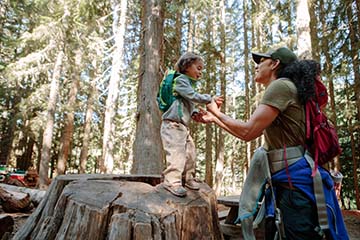 Risk-taking in childhood is not necessarily the same thing as "risky behaviors" that you hope your children will never try. Risk-taking for a toddler may look like taking a few steps without holding onto the furniture, or playing beside a friend even when mama is out of sight for a minute. For a preschooler, it may mean saying hello to a new friend, asking for a turn with a toy, climbing a tree, or trying a new vegetable. It could also mean trying to climb onto the top of the jungle gym or going up the slide.
For the average parent, these types of risks (with the exception of going up the slide) are not scary. When our toddlers take their first, unassisted steps, we clap and take videos and cheer them on. We encourage this type of risk.
Although we know they will definitely fall down at some point, we support our children's efforts to walk. But why?
Risk-taking in childhood is not necessarily the same thing as "risky behaviors" that you hope your children will never try. Risk-taking for a toddler may look like taking a few steps without holding onto the furniture, or playing beside a friend even when mama is out of sight for a minute. For a preschooler, it may mean saying hello to a new friend, asking for a turn with a toy, climbing a tree, or trying a new vegetable. It could also mean trying to climb onto the top of the jungle gym or going up the slide.
For the average parent, these types of risks (with the exception of going up the slide) are not scary. When our toddlers take their first, unassisted steps, we clap and take videos and cheer them on. We encourage this type of risk.
Although we know they will definitely fall down at some point, we support our children's efforts to walk. But why?
 Sarita Li Johnson believes in unstructured play, inquiry-based learning, and road tripping as much as possible. You will often find her and her two roadschooling children somewhere between Denver, Colorado, and Morro Bay, California. Follow along on Instagram @thelandlockedmama.
The opinions expressed in this blog are those of the author and not necessarily the opinions, thoughts, or recommendations of Hike it Baby.
Image courtesy Michelle Pearl Gee.
Sarita Li Johnson believes in unstructured play, inquiry-based learning, and road tripping as much as possible. You will often find her and her two roadschooling children somewhere between Denver, Colorado, and Morro Bay, California. Follow along on Instagram @thelandlockedmama.
The opinions expressed in this blog are those of the author and not necessarily the opinions, thoughts, or recommendations of Hike it Baby.
Image courtesy Michelle Pearl Gee.
Risk-Taking and Independence
In another life, before I was a mom, I was an infant/toddler specialist. I even taught preschool on the campus of a lovely university in Indiana. Although parenting is almost never anything like classroom teaching, some of the lessons I learned back then really stuck. Lesson number one: Let the kids take risks.
Risk-taking in childhood is not necessarily the same thing as "risky behaviors" that you hope your children will never try. Risk-taking for a toddler may look like taking a few steps without holding onto the furniture, or playing beside a friend even when mama is out of sight for a minute. For a preschooler, it may mean saying hello to a new friend, asking for a turn with a toy, climbing a tree, or trying a new vegetable. It could also mean trying to climb onto the top of the jungle gym or going up the slide.
For the average parent, these types of risks (with the exception of going up the slide) are not scary. When our toddlers take their first, unassisted steps, we clap and take videos and cheer them on. We encourage this type of risk.
Although we know they will definitely fall down at some point, we support our children's efforts to walk. But why?
What Adults Know About Taking Risks
As an adult, you've probably memorized all kinds of mantras about why risk is necessary for growth: "No pain, no gain." "You'll never know unless you try." "The journey of a thousand miles begins with one step." Most of us know that we need to push our own boundaries and step outside our comfort zones in order to grow. Some of us have learned this through therapy and personal development coaching, others through decades of missed opportunities. Some of us were lucky enough to learn these lessons during childhood or adolescence. However, many of us still hover around our young children, waiting to catch them after every step or shouting things like, "Be careful! Don't fall! Don't climb on that! Get down before you hurt yourself!" It's natural to want to protect our children, and I'm not suggesting that we send our toddlers out to play in the street. However, many of us could stand to take a deep breath and help our little ones learn to analyze and embrace risk. Early childhood educators are trained to help children assess risky situations and learn to be safe without being paranoid. Parents can learn to foster this type of awareness, as well, although it's not always the easiest thing to do. To get a better understanding of the difference between risks and hazards, check out this post from our archives: The Do's and Don'ts of Risky Play. ******************* It's (slightly) easier to let your little ones take acceptable risks when you're surrounded by other parents who are on a mission to do the same thing. (Positive peer pressure, right?) Connect with local parents and caregivers who are happy to help you take a deep breath and just let your child play. Learn more about Hike it Baby's mission and how you can get involved.About the Author
Sarita Li Johnson believes in unstructured play, inquiry-based learning, and road tripping as much as possible. You will often find her and her two roadschooling children somewhere between Denver, Colorado, and Morro Bay, California. Follow along on Instagram @thelandlockedmama.
The opinions expressed in this blog are those of the author and not necessarily the opinions, thoughts, or recommendations of Hike it Baby.
Image courtesy Michelle Pearl Gee.
About Hike it Baby
Hike it Baby is a 501(c)(3) non-profit organization dedicated to getting families outdoors and on trails across the U.S. and internationally, supporting, educating and inspiring families through their more than 300 communities across North America. Since its grassroots inception in 2013 in Portland, Oregon, Hike it Baby is now a growing community of 270,000 families and 500 volunteer branch ambassadors hosting more than 1,600 hikes per month. More information, as well as daily hike schedules, can be found at HikeitBaby.com, Facebook, YouTube, Pinterest, and Instagram.
Editors Note:
We hope you enjoyed reading this article from Hike it Baby. We’re working hard to provide our community with content and resources that inform, inspire, and entertain you.
But content is not free. It’s built on the hard work and dedication of writers, editors, and volunteers. We make an investment in developing premium content to make it easier for families with young children to connect with nature and each other. We do not ask this lightly, but if you can, please make a contribution and help us extend our reach.
Related Content



Comments