
The Ultimate Beginner’s Guide to Backpacking with Babies - part 3: 5 Things We Wish We Knew Before Our First Trip

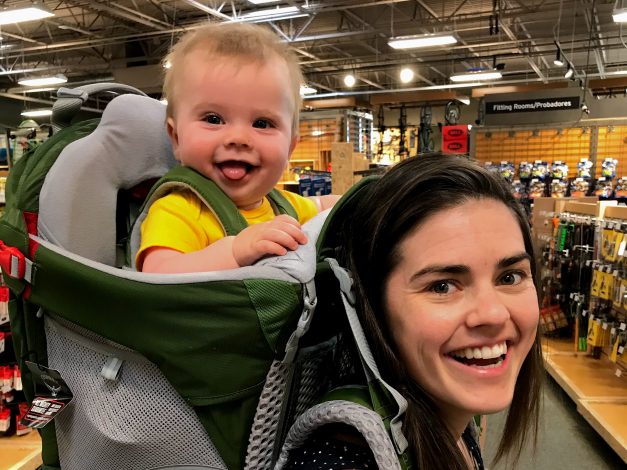 The picture above was taken when our son, Squeaks, was fitted with his pack for the first time. It was also the point I knew that my dreams of sharing my love for the mountains through backpacking with him could be a reality.
And how hard could it be, right? I’ve hiked the entire John Muir Trail and much of the cross-country Sierra High Route. My gear list is dialed in. Gordon Ramsey himself would devour my dehydrated sweet potato bark.
But like so many other facets of my life which parenthood has challenged, backpacking with a baby was no different. Here are 5 things we wish we knew before we set out on our family backpacking adventures.
(This is part 3 of our Backpacking with Babies series. Be sure you to check out the first part of this series in which we discuss the backpacking basics with a baby on board. And Part 2 talks about gear that's adapted for backpacking with babies.)
The picture above was taken when our son, Squeaks, was fitted with his pack for the first time. It was also the point I knew that my dreams of sharing my love for the mountains through backpacking with him could be a reality.
And how hard could it be, right? I’ve hiked the entire John Muir Trail and much of the cross-country Sierra High Route. My gear list is dialed in. Gordon Ramsey himself would devour my dehydrated sweet potato bark.
But like so many other facets of my life which parenthood has challenged, backpacking with a baby was no different. Here are 5 things we wish we knew before we set out on our family backpacking adventures.
(This is part 3 of our Backpacking with Babies series. Be sure you to check out the first part of this series in which we discuss the backpacking basics with a baby on board. And Part 2 talks about gear that's adapted for backpacking with babies.)
1. Practice Planned Flexibility
My wife once told me she thinks I enjoy planning for hikes more than the actual walking. I can’t say I completely disagree, and if my knees could speak after 5 miles of ground-pounding downhill, they would side with her. It’s not that I’m out of shape or that I’m allergic to nature, it’s just that I’m a spreadsheet GOD. I mean my spreadsheets have spreadsheets. There is something comforting about having the itinerary dialed in so much that I know the exact mileage to get to the perfect campsite with the softest dirt and most epic vista. It took all of 5 minutes into a 20-mile backpacking trip with our son to realize this type of hypervigilant planning wasn’t going to fly. In that short time, he made it very clear to us (and everyone else in the Sierras that morning) he had no intention of staying in the carrier for one more minute. So we stopped, took a break, and after some repositioning of his harness and coaxing through song, we managed to tame the beast and get back on trail. We begrudgingly walked on, feeling embarrassed and leery of what was to come. Was all of this a big mistake? Are we over our heads? Is it selfish of us to impose this foreign lifestyle on such a little human? These negative thoughts lingered for a few miles, but as we traipsed deeper into the mountains, they washed away to reveal new feelings of rapture toward the land’s scenery we were passing through. Part of this change in thought was attributed to our son’s mindful eye and the way he interacted with nature. As we allowed ourselves to stop to admire the curious ways he went about exploring rock patterns and pine needle textures, time and space slowed, and any sense of urgency and expectation faded. There were more important things happening here.You may still struggle with the egocentric inner voices of the backpacker who “once was” pre-baby. Try your hardest to ignore these urges to push harder, go faster and climb higher – you will probably have a better time! If you do have the time, give yourself the opportunity to fulfill these urges on different, kid-free trips.
2. There Is No Ultralight Version
When I go out on my “Adventure Dad” trips (backpacking trips without little people), I meticulously maintain a LighterPack account where I log every ounce of gear down to the last Band-Aid. It’s a fool-proof way of making sure everything is accounted for on a trip. Due to its success, I thought it only made sense to start such a list for our family outings. We were initially doing “ok” on weight until we added the 18 pounds of grubbulous squish that was my son at 10 months; the 3-person tent; the double sleeping pad; and the bear canister with food pouches. As we watched the pounds skyrocket, we gave up any hope that this was going to be a lightweight affair. It was time to embrace our inner “pack mule.” This meant breaking out the big guns – or in our case, mitigating heavier weights with a few helpful strategies:- Carrying a bigger pack to manage larger volume and weight - I usually keep gear in a smaller, lightweight frameless pack. These packs are not meant to be used when the total weight of gear exceeds 30-35 pounds. But backpacking with Squeaks, I was easily pushing 40+ pounds in my backpack with all the gear. I ended up using a 70L pack, which not only had the extra volume but carried the weight well.
- Using a balanced pack - When carrying heavier loads, making sure your pack is evenly balanced is key. Here are some tips on loading your backpacking by L.L.Bean.
- Using trekking poles - Trekking poles are always a good idea when backpacking, but they’re especially helpful when carrying heavier weights. They improve balance and reduce the impact on your knees and leg muscles.
3. You May Have to Play the “Napping Game”
Squeaks was colicky as an infant and the only thing that would get him to sleep was walking. During the “dark ages,” we walked from sun up to sun down to get him to sleep. We still attribute his love for hiking to our rambler ways of old. Consequently, it did not surprise us that he was a good sleeper on trail. Now it wasn’t always the prettiest looking position, but the kid slept. Well, he slept as long as we were moving …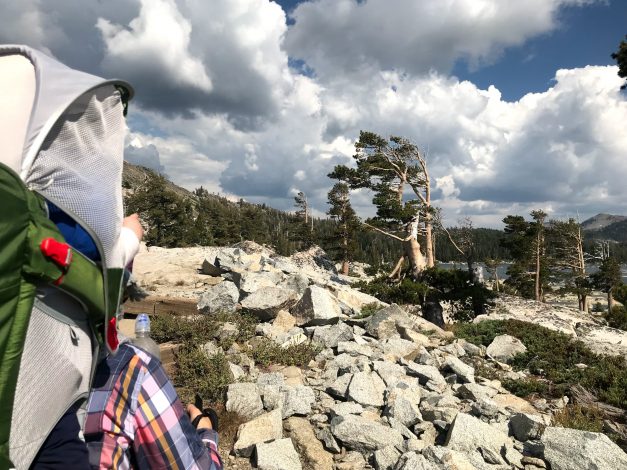 This meant we were often left playing the “Napping Game,” which is a game of sleep time logistics. I’m sure many parents are all too familiar with it. Here are two examples of how this game played out on trail for us:
- If Squeaks fell asleep at 3 p.m. and we were only .5-mile from our proposed camp, we would either have to walk past our campsite to another site farther down trail or walk in circles around our campsite until he had been down for about an hour. We’ve done both.
- If Squeaks fell asleep at the start of a 2-mile uphill climb of 1500 feet, there was NO STOPPING. We could not stop to catch our breath, drink water or even talk to the nice couple who looked at us like we were going the wrong way heading farther into the backcountry.
If you are incapable of drinking water while walking (like someone’s mama I know) and you have a sleepwalking kid like ours, bring a bladder with a hose so you can drink and walk!
4. Babies Are Not Quiet
Many backpackers venture out to embrace the solitude and quiet reprieve that the wilderness offers. We believe it is our duty to respect this need, whether it be on trail or in camp. That said, we are carrying a baby and babies are not quiet! On one particular trip in the Sierras, after 8 grueling miles of walking, we crawled into our campsite with a perfect spot overlooking a pristine alpine lake. I had just blown up our 2-person pad when I noticed a hammock set up on the other side of a tree just 50 feet away. After a little investigation, I quickly learned that this hammock belonged to a man who was backpacking with his wife. We relocated as best as we could immediately to a less ideal spot, but in the end we were glad we did so. That night, Squeak’s side of our pad deflated and it was this dad’s job to blow it up every hour (we chose this option rather than dunking the pad into the frigid water in the middle of the night to find and repair the leak). Needless to say it turned out to be a very noisy night!If your tent site options are limited and you are worried about your baby keeping others awake, be sure to talk to your neighbors about your “situation,” or even pack out ear plugs to offer to other groups!
5. Embrace Your Inner “Dirtbag”
When you’re backpacking, dirt is simply unavoidable. It will fill the cracks in your dry hands and embed itself in your toenails. There will come a point where you will wash your hands clean in a body of water and wipe them dry with your shirt, pants, towel or handkerchief … only to look down and find them just as dirty again. Like your hands, if you try to keep a baby clean in the woods, you will lose! Babies have more cracks and crevasses than glaciers, as I'm sure you discovered this when you were struck by a strange smell coming from your baby and found a "fold" that hadn't been cleaned for some time. We challenge you to embrace your inner “dirtbag!” Unless you plan on packing out pounds of wipes (which you'll have to haul out), forget about the folds for a few days. Forget the face. Forget the feet. And forget the fingers. If you need to hone in on an area, let it be the baby bits. Diaper rashes are not to be messed with on trail!Parenthood has thrown many new humbling experiences our way and backpacking with a baby was one of them. But with all the failures and lessons learned in the mountains, there has come a newfound sense of inspiration to change what it means to enjoy the wilderness and share that idea with our son. We would not have had it any other way. Comment below and tell us some of the lessons you’ve learned while backpacking with your little one.Dehydrate your wipes beforehand! Leave them out in a dry place for 24 hours before your trip to save weight! Reconstitute with water when you need them.
Read more:
- The ultimate beginner's guide to backpacking with babies: The basics
- The ultimate beginner's guide to backpacking with babies - Part 2: Gear List
- Backpacking 101: The next adventure
- Backpacking 102: Taking the kids
Related Content



Comments