
How nature can help in the battle against cancer

Editor’s Note: This article discusses childhood cancer and may be triggering for some readers. There is a memory I cherish of my family that I keep for myself. No photo can touch that moment. It’s a crisp August morning in Utah’s High Uintas. Actually its the weekend before school starts for my oldest. It was our final big escape into the wild before we kissed the beautiful summer goodbye.
The sun had barely begun to light the sky and my husband, Chad, was getting his boots on to start a fire. It was so tempting to stay tucked in between my babies. My Penny was on the verge of 4, and Maddox was just about 9. No matter how big they get, there is something about seeing them warm and cozy in their sleeping bags. They both backpacked into this spot and deserved this sleep; they both carried decent weight for how old they were.
While they were adorable, I couldn’t resist the sunrise that was looming. I got my socks and boots on, holding my breath and hoping they would sleep through my rummaging. I ran into the forest and found a rock wall easy enough to scale. Making my way to the top, I inched myself to the edge where, the day prior, the kids saw someone cliff diving. I sat in the stillness that comes the moment before the sunrise. Watching the mist creep across the lake and into the forest, I sat and silently laughed to myself, “It’s freezing up here! Who does this?!” Well, my family does. This wasn’t the way I was raised, but it was for Chad and this is what we want for our children. The comfort and familiarity of nature and its surroundings are moments that cannot be bought or duplicated.
There is a memory I cherish of my family that I keep for myself. No photo can touch that moment. It’s a crisp August morning in Utah’s High Uintas. Actually its the weekend before school starts for my oldest. It was our final big escape into the wild before we kissed the beautiful summer goodbye.
The sun had barely begun to light the sky and my husband, Chad, was getting his boots on to start a fire. It was so tempting to stay tucked in between my babies. My Penny was on the verge of 4, and Maddox was just about 9. No matter how big they get, there is something about seeing them warm and cozy in their sleeping bags. They both backpacked into this spot and deserved this sleep; they both carried decent weight for how old they were.
While they were adorable, I couldn’t resist the sunrise that was looming. I got my socks and boots on, holding my breath and hoping they would sleep through my rummaging. I ran into the forest and found a rock wall easy enough to scale. Making my way to the top, I inched myself to the edge where, the day prior, the kids saw someone cliff diving. I sat in the stillness that comes the moment before the sunrise. Watching the mist creep across the lake and into the forest, I sat and silently laughed to myself, “It’s freezing up here! Who does this?!” Well, my family does. This wasn’t the way I was raised, but it was for Chad and this is what we want for our children. The comfort and familiarity of nature and its surroundings are moments that cannot be bought or duplicated.
There is a memory I cherish of my family that I keep for myself. No photo can touch that moment. It’s a crisp August morning in Utah’s High Uintas. Actually its the weekend before school starts for my oldest. It was our final big escape into the wild before we kissed the beautiful summer goodbye.
The sun had barely begun to light the sky and my husband, Chad, was getting his boots on to start a fire. It was so tempting to stay tucked in between my babies. My Penny was on the verge of 4, and Maddox was just about 9. No matter how big they get, there is something about seeing them warm and cozy in their sleeping bags. They both backpacked into this spot and deserved this sleep; they both carried decent weight for how old they were.
While they were adorable, I couldn’t resist the sunrise that was looming. I got my socks and boots on, holding my breath and hoping they would sleep through my rummaging. I ran into the forest and found a rock wall easy enough to scale. Making my way to the top, I inched myself to the edge where, the day prior, the kids saw someone cliff diving. I sat in the stillness that comes the moment before the sunrise. Watching the mist creep across the lake and into the forest, I sat and silently laughed to myself, “It’s freezing up here! Who does this?!” Well, my family does. This wasn’t the way I was raised, but it was for Chad and this is what we want for our children. The comfort and familiarity of nature and its surroundings are moments that cannot be bought or duplicated.
The wild was our home and where we belong
I sat there and reflected over all the things we had accomplished over the last few months. Maddox never understood or enjoyed competing against other kids, but had learned to push himself to go just a little bit further or climb just a bit higher. And Penny was my little mountain babe who was fearless. She protected us from the bears and howled like a wolf down 100-foot rappels. These two had logged in more miles on the trails than most adults I knew and they weren’t even close to being teenagers. Sure, we did it at a pace of a 3-year-old, but allowing them to grow into hiking gave them a confidence few people know. Maddox begged to bag some of those big peaks and Penny had managed five miles on her own with over 1,500 feet of elevation gain! Nature taught my kids how to rely on each other while being able to rely on themselves. I watched the sun rise over the mountains and over the lake; I was truly happy. And so very proud. This was never where I imagined my life to be – sitting on a cliff and stripping off my layers because, damn, it was getting warm fast. I heard my wildlings laughing with Chad as I sat up there, debating how long I could keep that moment. I had decided right then and there that life wasn’t going to just happen to us; this lifestyle of dusty boots and chasing sunrises is where we fit best.The outdoors was a way of life for us
Autumn and winter went by in a flash with weekends of camping in the snow, date nights on top of frozen mountains, trips to the desert and all the snowshoeing we could do! As the new year rolled around, we made ridiculous goals of new places and all the hikes we were going to get in. Adventure through the Ozarks, backpack in the Tetons, an epic Pacific Northwest trip was a must. And, of course, Penny always demanded Goblin Valley. By the end of February, we had already managed a crowdless Arches, the beautiful views of Canyonlands, bouldering in Joshua Tree, moonlit hikes and we even saw the Hoover Dam. Maddox and Penny thrived in a way we never thought possible. It took a lot of scheduling but every moment was worth it. Our family had found that coveted sweet spot. Then Penny got cancer and all those beautiful moments that once seemed so easy are now riddled with red flags. But kids stumble on hikes, and kids puke on road trips and kids sleep for hours on end. Not our adventure babe – she gets to have cancer. I raged, raged against it all. I wouldn't let it define us; cancer wouldn't take away everything we have worked so hard for!We refused to be defined by cancer
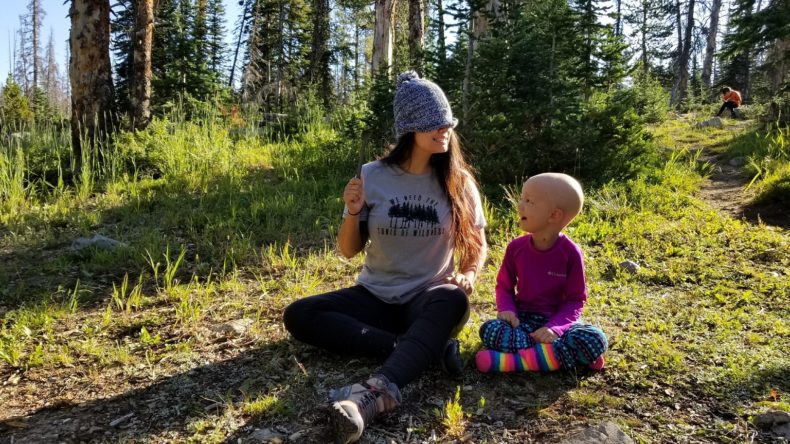
Sometimes I wonder ... maybe if they would have gotten the tumor with the first surgery, or the surgery the next day. Or maybe if Penny could have walked and spoken when she woke up, or maybe after the third surgery that month and all the radiation. Then maybe it wouldn’t have defined us. But still we fought. Even when there was nothing left and my child was a shell of the girl she was, we laid in the rain. When our family was separated for months, Chad and Maddox bagged their first peak together. When Penny's hair was falling out, I carried her into the forest. And when she was bald and left the hospital after another round of chemo and asked to go backpacking, I carried her on my back so we could watch the sunset over a lake. Nature is no longer an easy thing for us to escape to – it’s hard. Nature reminds my family of everything that was taken from us. Everything we loved as a family as well as individuals. My mountain goat of a daughter now has to be carried everywhere and she hates it. She’s embarrassed and I’m angry. Maddox is lonely and Chad is a father trying to do what he can. But once we move past the hard things and the scary things and the things we don’t want to do, nature also reminds us who we are. It picks us up and reminds us how one foot in front of the other will get us to the top.
Getting outside helps us move forward each day
Right now, everything is much harder, so when we do get out into nature, everything is also sweeter. Penny will beg to pick the wildflowers just to put them in my hair. Maddox will hide in a tree or on a boulder to read in peace in a place that gives him comfort. Chad picks the right spot for the night and can’t wait to bust out his water filter or stove, reaffirming he can take care of us. And I still sneak away and find moments to reflect and remember. When things get too hard and we can’t keep up with the horrors of childhood cancer, we get outside. We take full breaths again and revel in the small things. While nature has become so hard for us, it is still where our hearts find joy. It is where we find peace and grounding, and where we recharge and get ready to move forward every day. Sachi Honjo Thornley is an ambassador for Adventure Mamas and member of Hike it Baby. She lives in Salt Lake City with her family. Her daughter, Penny, is battling Medulloblastoma, which is more commonly known as a pediatric brain tumor.Read More:
Photos courtesy of Sachi Honjo Thornley.Related Content



Comments