Hard-framed carrier: improve the quality of your hike

  1. Share
0 0
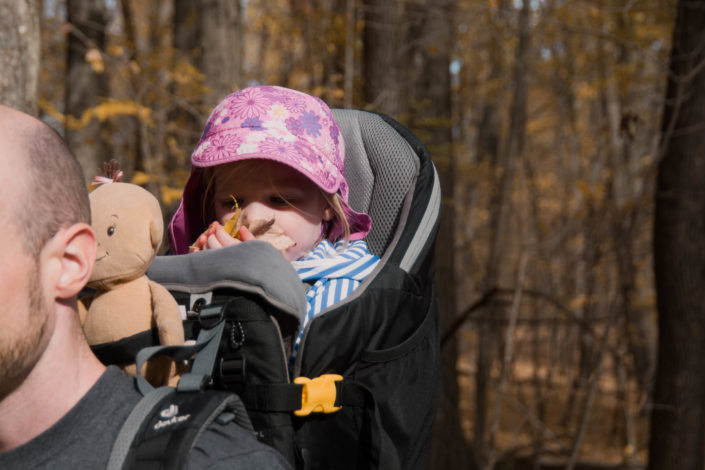
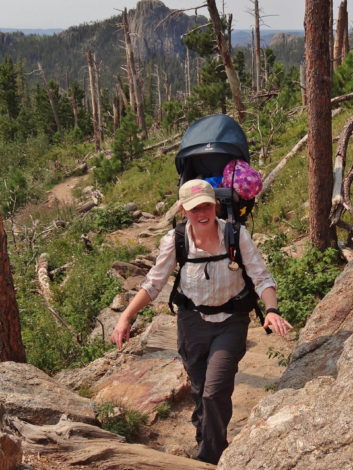
Sky was a little over a year old when I was finally mentally prepared enough to try a long day hike. I felt confident in what I would need for a full day's hike: 15 diapers, first aid kit, water for a family of eight, food for three days, three outfit changes and rain gear. With everything I needed, I was concerned about having to carry everything I would need with me, a one-year-old and my overactive imagination. Sky was starting to get heavy and I was concerned about footing, so I wanted her on my back, but my buckle-style carriers weren’t prepared to stuff everything. I wasn’t sure I really wanted to carry Sky on my back and a backpack on front (sounded super awkward). Enter the hard-framed carrier. Hard-framed carrier: improve the quality of your hike by Jessica Featherstone for Hike it Baby Hard-framed carriers (like my beloved Deuter Kid Comfort III) are typically designed to carry both gear and kids. Some don’t have gear compartments ... just skip those. A hard-framed carrier is different from your typical soft-framed carrier or buckle-style carrier. They have an internal frame so your little one sits higher behind you for a great view. Hard-framed carriers are designed to sit differently on your body above your hips, similar to a framed backpack and unlike the typical soft-framed carrier or buckle-style, which can sit anywhere from natural waist to hip.
A proper fit is important for comfort

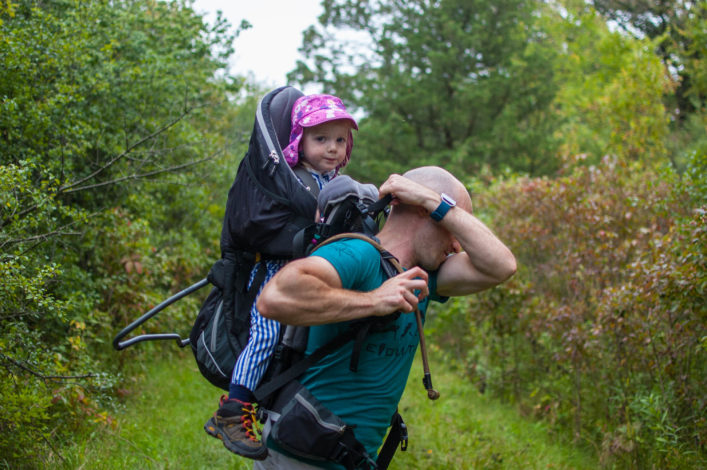
Torso Length – Adjust your carrier so that the hip belt will sit on your hips and the weighted carrier’s shoulder straps won’t have a gap on your shoulders. Take the time before you head out on the trail to get this perfect for you. I grabbed a sack of potatoes and tossed it into the seat to get a great fit. I had my partner help me get the perfect fit by some trial and error on adjusting by using their Varifit system. Since it’s an easy strap to adjust, we also marked my partner’s best fit so we could go between the two of us easily. Waistbelt – Put it on your hips. It belongs there. Don’t think of this carrier like your typical Tula or Ergobaby carrier. It’s designed like a backpack and you have to think of adjusting it like that. Shoulder straps – Is there a gap? Is the bottom of the strap under your armpit? Tighten as needed to get your fit. It’s easier to loosen to get the pack on and off as well. Load Adjustment Straps – Those straps going from your shoulder to the pack? Those are the load adjustment straps and perfect for adjusting the pack either closer to you or farther away. Try playing with these as well to see what you like. Hard-framed carrier: improve the quality of your hike by Jessica Featherstone for Hike it Baby

Comfort for your kiddo

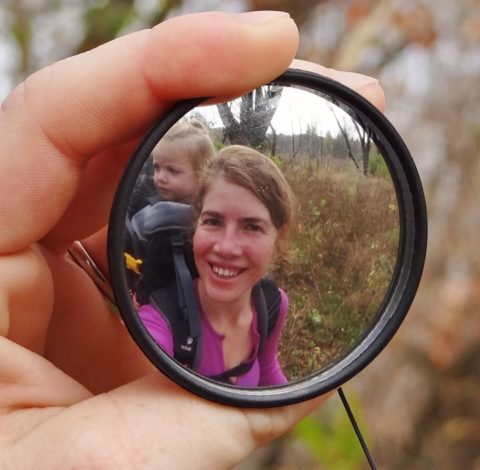
The hard-framed carriers are also designed with adjustments to help your little one feel comfortable as well. Seat – Look for the seat adjuster to get the right height. You want your child’s head to be above the front of the cockpit with their shoulders below the back rest. If you have a Kid Comfort III like me, I have my daughter periodically rest her head on the pillow so I can make sure she is comfortable when napping. Feet – Look for the stirrups and adjust these so your child’s knees are slightly bent. Harness – Make sure that the harness is snug against your child so they can’t wiggle out (I’ve learned this lesson for you.). Harnesses typically have several points to tighten so you can adjust to the child in that moment. The Deuter Kid Comfort III allows me to move the shoulder straps up and down, so Sky has a perfect fit. You want to make sure the harness is snug as this is what keeps your child in the cockpit. Accessories – If your carrier doesn’t come with it automatically, consider picking up a sunshade. I also highly recommend grabbing the rain protector as it’s very helpful for rain, snow and wind. You may also want to pick up a mirror like this one. It attaches to your carrier and will allow you to view your child. Hard-framed carrier: improve the quality of your hike by Jessica Featherstone for Hike it Baby

Extra tips for using a hard-framed carrier

Your baby needs to sit independently. These carriers aren’t designed for kids who can’t sit independently, so don’t use it for newborns or any child who isn’t sitting independently. Each child hits this milestone in their own time. Mind the weight. Each framed carrier has a max weight it can safely carry to include the child, gear, water and the carrier. Sky is a little thing so we have been able to use this carrier for a long time. Each time I consider how much everything weighs (water is heavier than you think). If you are thinking about doing longer hikes and want to take gear along, a hard-framed carrier might be your perfect fit. For me and Sky, it’s allowed us to hike to the top of Black Elk Peak, backpack the Ice Age Trail, keep us on the trails longer and let me do more adult-paced hikes. Hard-framed carrier: improve the quality of your hike by Jessica Featherstone for Hike it Baby

Read more:

Photos by Jessica Featherstone. Do you have a fit tip for a hard-framed carrier? Let us know below!  

Community tags

This content has 0 tags that match your profile.

Let's Talk Gear & Snacks

Comments

To view comments or leave a comment, login or sign up.

Related Content

0
How to babywear in the rain
Oregon means rain. And a lot of it. Like six months or more of it. There is no escaping it. But that doesn’t mean you can’t wear your baby for half of the year here. Here are a few tips to babywear in the rain and keep you, baby and carrier dry! Don’t worry too much about your carrier. Mud washes out. Wet dries. It takes a lot to truly ruin a carrier. Even a silk woven wrap will probably be okay after a romp in the rain. That being said, if you have a very special carrier, it might be best just to leave it safe at home. Always make sure baby’s airway is unobstructed, so any hoods, covers, ponchos or whatever you use to keep dry must not cover baby’s face. Breathing is always more important than dryness. And never alter the design of the carrier or put added stress on it. No babywearing accessories should compromise the integrity of your carrier. Safety is also more important than dryness. Umbrella I know it’s very un-Oregonian to suggest this, but an umbrella is an effective and easy way to keep dry while babywearing in the rain. It’s also inexpensive. Just put on baby’s and your normal appropriate outerwear, pop open the umbrella and go! This is a good option for when it’s just sprinkling or raining on and off. Or when it’s not cold and there's no jacket trapping in body heat. If you get a large enough umbrella—like a golf umbrella—this makes a great option for tandem wearing. The downside is you need to hold it the entire time. It also may bounce around as you walk and may not always cover baby (especially in a back carry). If you are tandem wearing, you'll need to pay extra attention to keep both kids covered. And another thing to consider is that kids like to grab them and possibly whack you. Babywearing jacket A babywearing jacket is designed to accommodate baby and carrier. Some are even designed for tandem wearing. They either have an extra panel zipped in or are bigger, with a cutout or hood for baby’s head. Put baby in the carrier, put on the jacket and enjoy some hands-free wearing in the rain! However, there are a few downsides. First, they can be expensive (though they do come up for reasonable prices in co-ops often). You also need to make sure you get the right size for both you, baby (babies for tandem) and carrier. And keep in mind that baby will grow, so you may need to buy on the larger side so it lasts longer. They are not commonly found it stores, so trying on for sizing is not usually possible. ​ But most are wonderful at keeping you, baby and carrier dry, so once you get one you like and that fits, you won't regret it! Carrier Cover A carrier cover is a great way make sure baby and the part of the carrier in contact with baby stays dry. This is a piece of waterproof fabric that goes over the front of the carrier with a hood for baby. You still need to put a jacket over you and the back of the carrier (if your carrier isn’t waterproof). Put baby in carrier, put on cover, then your jacket, and enjoy come snuggles in the rain. Most buckle carrier brands make covers designed for their specific carrier. There are also generic ones that can work with most carriers as well, including wraps and ring slings. The downside is the cover is separate from you, so there is the risk of rain leaking in. Also, the cover doesn't go around your back, so the back of your carrier may get wet or you may still need a babywearing or larger jacket over your back. Keep in mind that they are designed to go on easiest for front carries. You can use them for back carries, but someone else may need to put it on for you, and you'll need to buy two of them. If all else fails, just put a waterproof coat on you, one on baby and dry your carrier later. A little water doesn’t hurt; it might even add to your fun! Just make sure baby doesn't get too cold, risking hypothermia. Keeping baby as dry as possible in a waterproof layer and snuggled close to your body should keep baby warm. For information on layering baby to stay warm for the cold, check our post on layering for the cold! Happy babywearing in the rain!!!! What kind of creative ways do you try to babywear in the rain? We'd love to hear your tips and tricks in the comments below. Read more: 5 Comfy and cozy winter carriers for babywearing Tandem babywearing tips - How to carry two small hikers How to layer when babywearing in the cold Photo by Amy Diebold. This post was sponsored by Onya Baby. ABOUT OUTGROWN OutGrown is a 501(c)(3) nonprofit that works to create a world where everyone can enjoy the physical and mental benefits of spending time outside. We are focused on creating opportunities and removing barriers to access so families with babies and young children can take their first steps outside. We believe all families have the right to connect with nature, benefit from spending time outdoors and be inspired to a lifelong love of nature. Since its grassroots inception in 2013, OutGrown is a growing community of 280,000 families and over 300 volunteer Branch Ambassadors. More information on all of our programs can be found at WeAreOutGrown.org    EDITORS NOTE: We hope you enjoyed reading this article from OutGrown. We’re working hard to provide our community with content and resources that inform, inspire, and entertain you. But content is not free. It’s built on the hard work and dedication of writers, editors, and volunteers. We make an investment in developing premium content to make it easier for families with young children to connect with nature and each other. We do not ask this lightly, but if you can, please make a contribution and help us extend our reach.  
0
How to tandem babywear while hiking
More children means more trail buddies. The joy on their sweet little faces as they see the wonders of nature around your family. However, more children also means more tired little legs. You may need to enter the realm of tandem babywearing – wearing two children in carriers at once. Here are some general tandem wearing tips to get you started. 1. As always, the general rules of babywearing apply. If you would not do an activity while holding multiple babies, then it’s probably not a good idea to do it while tandem wearing. For example, climbing up a steep cliff. 2. The safest recommendation is one carrier per child. And each carrier should be secured independent of the other. This also means no crossing straps or tying one carrier to another. That way, you could safely remove one child quickly if needed without the risk of the other falling out. 3. Make sure both children meet the general height and weight limits of their carrier. This will ensure both you and babies are comfortable and well-supported without the risk of falling. 4. Make sure you are comfortable using each carrier independently first before trying them together. You need to be able to prep them, place baby on your body, secure the carrier and remove baby safely on your own. 5. Keep in mind that two babies/kids mean double the weight. Make sure you can physically carry that much weight before you head out on the trail. A mile into your hike is a bad time to realize that both kids are too heavy! Try it out at home first. Your living room or backyard is the perfect place to practice securing both children in the carriers. Take a short stroll around the room or neighborhood to ensure you’re comfortable and stable. Ways to tandem wear on the trail Babies of the same size For newborns, it is best to invest in a carrier that is designed for multiples. Many of these models are specially designed to fit newborns and will be the easiest way to get the proper fit for tiny babies. Please note that most twin carriers are designed to wear both newborns on the front only. This is the safest place for small babies, especially from first time wearers. And remember that babies need to be faced inward, but ensure their airways aren’t obstructed. Once babies get bigger, especially when they are sitting upright unassisted, you can try almost any two carriers you like together. The most common option is two soft-structured carriers, like The Extend from Easy Feel Products. Adjustable carriers, like The Extend, are also a wonderful choice for hiking with babies because the carrier grows with baby. The body panel adjusts in height and width to provide support and keeps baby snuggled from newborn to toddler. With practice, soft-structured carriers are easy to put on and adjust. Make sure both carriers function independently, so stagger the waistbands around your waist, one on top of the other, and ensure you can access both buckles and all shoulder straps easily. Toddlers of the same size As babies grow into walking toddlers or preschoolers, you’ll probably tandem wear less so you may be able to get away with just one carrier on a hike and rotate each kid as his legs get tired. But, there will probably be times when both kids will want to be carried too. Soft-structured carriers once again are a great choice, as they have more padding and internal structure to hold up more wiggles – especially from two kids. Keep in mind that those little legs may want back down again on the trail – and often – so try wearing the kiddo who usually wants down first on the front and place that carrier’s shoulder straps on the top. That way it’s a quick slide down your front and you don’t have to fight with trapped shoulder straps. Baby and toddler Whether hiking with siblings or you’re helping another parent during a hike, there may be times when it’s necessary to carry two kids of different sizes and weights. We recommend making it as easy as possible. If you have a newborn or infant, using a stretchy wrap on the front is convenient for taking baby in and out for diaper changes and feeding. Then you can wear any carrier you like on your back for the older child. Just make sure you put the wrap on first (even before you put baby in) so that way the back carrier is on top so the older child can go up and down as needed without disturbing baby. Once your baby can sit upright unassisted, you can put either baby or toddler on your front or back and use any carrier you’d like! The best recommendation is still to wear the child who will want down the most on the front. However, keep in mind that it might be more comfortable to have your bigger child on your back. But keep in mind that testing out different positions and carriers at home before you hit the trail is your best bet for a successful tandem-wearing experience on the trail. Share with us what you love about tandem wearing to encourage and inspire others to do the same. Read more: Tandem babywearing tips - How to carry two small hikers Tandem babywearing on trail - Tips and Tricks Photos by Ashley Scheiber. This post was sponsored by Easy Feels Products.