
Hike it Baby for the Whole Family - One Dad's Perspective
- Blog Hike it Baby for the Whole Family - One Dad's Perspective

I’m a new father (my little girl is about 1.5 years old now) and I’ve always been a healthy/active/outdoors-loving kind of a person. When we had our daughter, my wife found a new group, Hike it Baby, whose sole purpose was to encourage and help facilitate families to get outside and enjoy nature, and that sounded right up my alley. As simple as it sounds, I’ve found it to be a lot more than just that.
 I made a large career change a little more than a year before we had our daughter, which meant moving to a new place hundreds of miles from both of mine and my wife's friends and family. As a new parent, this kind of situation makes things significantly more difficult across the board–with making friends, caring for the new baby, keeping one's sanity, etc. Getting out and hiking, if nothing else, does one thing without fail: it puts everyone in a better mood (if only for a little while for the baby). Anytime my daughter was in a crying mood and I had addressed all the standard concerns (followed by best guesses of what could be bothering her) with nothing else calming her down, I could always take her outside to look at or touch a tree and get some fresh air and 95% percent of the time she would calm down and relax for at least a little bit. The world of nature has that kind of effect on people.
I am more than happy to join the rest of my family on as many hikes as I can (sadly many of them are during the day when I’m at work, but there are plenty in the evenings and on the weekends that I can make). As a matter of fact, I always look forward to the hikes when my wife invites me to one and I always say yes to going (except that one time when some home maintenance was a priority). We started going out to local hikes and the first big additional benefit of joining the groups presented itself–meeting new people.
I made a large career change a little more than a year before we had our daughter, which meant moving to a new place hundreds of miles from both of mine and my wife's friends and family. As a new parent, this kind of situation makes things significantly more difficult across the board–with making friends, caring for the new baby, keeping one's sanity, etc. Getting out and hiking, if nothing else, does one thing without fail: it puts everyone in a better mood (if only for a little while for the baby). Anytime my daughter was in a crying mood and I had addressed all the standard concerns (followed by best guesses of what could be bothering her) with nothing else calming her down, I could always take her outside to look at or touch a tree and get some fresh air and 95% percent of the time she would calm down and relax for at least a little bit. The world of nature has that kind of effect on people.
I am more than happy to join the rest of my family on as many hikes as I can (sadly many of them are during the day when I’m at work, but there are plenty in the evenings and on the weekends that I can make). As a matter of fact, I always look forward to the hikes when my wife invites me to one and I always say yes to going (except that one time when some home maintenance was a priority). We started going out to local hikes and the first big additional benefit of joining the groups presented itself–meeting new people.
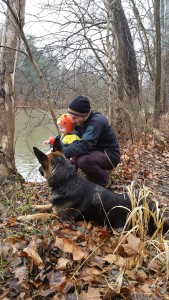 While I can’t say I’ve made any lifetime friends at the hikes, every single person I’ve met has been a quality individual in my book. The people come from all walks of life and in all different stages of family life which makes conversations very easy and often very helpful. As a new parent without friends or family nearby it’s really nice to be able to bounce questions, ideas, thoughts, or weird baby observations off of other people that are either going through it too, or have been through it. I’d have to say that the socialization aspect is great for me, and even needed. I also think that little 1.5 yr olds (like my daughter) get a lot out of the socialization as well. At every hike there are numerous social learning opportunities–how to interact with other toddlers and babies, how to interact with other adults, etc., all of which are very important pieces of the puzzle that is her growth and upbringing.
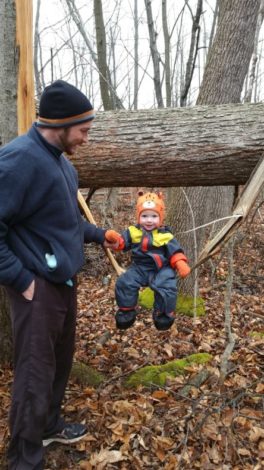
Along with meeting new people at many of these hikes, it’s been fantastic discovering new amazing places all over the city. I think I’ve probably experienced more parks and trails than any number of locals that have been in the area for years, or maybe even decades, longer than I have. There are some really fantastic trails and hiking areas where I live and before Hike it Baby I’d only been to a very small number of them. Everything from hill tops that look out over swaths of forest, to bluffs looking out over Lake Michigan, to deep overgrown forested woods, and well maintained bike trails–the variety is pretty extensive. One of my favorite places to go for the view is the bluffs that look out over the lake. When I want a solid, challenging hike, there are some amazing hills on the ice age trail. One of my favorite hikes was at a local, very basic park/trail. on the hike I found a fallen tree with a large strip of bark suspended between the base and the fallen section positioned perfectly for swinging. After testing it myself with my own body weight, pretty much every kid at the hike got a turn sitting on the bark and testing out their balancing skills and exposing them to a little bit of vertical height on a movable surface.
While I can’t say I’ve made any lifetime friends at the hikes, every single person I’ve met has been a quality individual in my book. The people come from all walks of life and in all different stages of family life which makes conversations very easy and often very helpful. As a new parent without friends or family nearby it’s really nice to be able to bounce questions, ideas, thoughts, or weird baby observations off of other people that are either going through it too, or have been through it. I’d have to say that the socialization aspect is great for me, and even needed. I also think that little 1.5 yr olds (like my daughter) get a lot out of the socialization as well. At every hike there are numerous social learning opportunities–how to interact with other toddlers and babies, how to interact with other adults, etc., all of which are very important pieces of the puzzle that is her growth and upbringing.
Along with meeting new people at many of these hikes, it’s been fantastic discovering new amazing places all over the city. I think I’ve probably experienced more parks and trails than any number of locals that have been in the area for years, or maybe even decades, longer than I have. There are some really fantastic trails and hiking areas where I live and before Hike it Baby I’d only been to a very small number of them. Everything from hill tops that look out over swaths of forest, to bluffs looking out over Lake Michigan, to deep overgrown forested woods, and well maintained bike trails–the variety is pretty extensive. One of my favorite places to go for the view is the bluffs that look out over the lake. When I want a solid, challenging hike, there are some amazing hills on the ice age trail. One of my favorite hikes was at a local, very basic park/trail. on the hike I found a fallen tree with a large strip of bark suspended between the base and the fallen section positioned perfectly for swinging. After testing it myself with my own body weight, pretty much every kid at the hike got a turn sitting on the bark and testing out their balancing skills and exposing them to a little bit of vertical height on a movable surface.
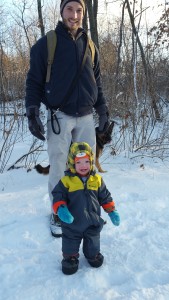 As I mentioned, the world of nature has some fantastic benefits in improving ones mood. While we are out hiking a path or a trail, there are little things that constantly make me happy to be outside and exploring. Watching my daughter build her strength in walking, running, and climbing on all manner of surfaces, I recognize the benefit and unique opportunity each hike brings to her development and I am in constant awe of her continuous growth and improving skills. Watching her go from a stumbling toddler to a running toddler has been just plain awesome. I’ve been able to watch her navigate sticks and branches, hills and slopes, mud and snow, with increasing skill week after week and it’s truly fantastic. I’m particularly looking forward to the future with her and my wife as we are planning to do some backpacking and camping. I’m excited to share all the fun natural wonders of the outdoors with my daughter and am very glad my wife found this group and invited me along.
 Daniel Featherstone is an Engineer living a bit north of Milwaukee, Wisconsin with his wife, 1.5 year old daughter, and two dogs. Most of his time not at work is spent encouraging a toddler to explore, playing hockey in a beer league and training his German Shepherd. Daniel gets his love of adventure and nature from his parents who used to take him camping and encourage him to play outside in the woods and back yard at every opportunity.
I made a large career change a little more than a year before we had our daughter, which meant moving to a new place hundreds of miles from both of mine and my wife's friends and family. As a new parent, this kind of situation makes things significantly more difficult across the board–with making friends, caring for the new baby, keeping one's sanity, etc. Getting out and hiking, if nothing else, does one thing without fail: it puts everyone in a better mood (if only for a little while for the baby). Anytime my daughter was in a crying mood and I had addressed all the standard concerns (followed by best guesses of what could be bothering her) with nothing else calming her down, I could always take her outside to look at or touch a tree and get some fresh air and 95% percent of the time she would calm down and relax for at least a little bit. The world of nature has that kind of effect on people.
I am more than happy to join the rest of my family on as many hikes as I can (sadly many of them are during the day when I’m at work, but there are plenty in the evenings and on the weekends that I can make). As a matter of fact, I always look forward to the hikes when my wife invites me to one and I always say yes to going (except that one time when some home maintenance was a priority). We started going out to local hikes and the first big additional benefit of joining the groups presented itself–meeting new people.
While I can’t say I’ve made any lifetime friends at the hikes, every single person I’ve met has been a quality individual in my book. The people come from all walks of life and in all different stages of family life which makes conversations very easy and often very helpful. As a new parent without friends or family nearby it’s really nice to be able to bounce questions, ideas, thoughts, or weird baby observations off of other people that are either going through it too, or have been through it. I’d have to say that the socialization aspect is great for me, and even needed. I also think that little 1.5 yr olds (like my daughter) get a lot out of the socialization as well. At every hike there are numerous social learning opportunities–how to interact with other toddlers and babies, how to interact with other adults, etc., all of which are very important pieces of the puzzle that is her growth and upbringing.
Along with meeting new people at many of these hikes, it’s been fantastic discovering new amazing places all over the city. I think I’ve probably experienced more parks and trails than any number of locals that have been in the area for years, or maybe even decades, longer than I have. There are some really fantastic trails and hiking areas where I live and before Hike it Baby I’d only been to a very small number of them. Everything from hill tops that look out over swaths of forest, to bluffs looking out over Lake Michigan, to deep overgrown forested woods, and well maintained bike trails–the variety is pretty extensive. One of my favorite places to go for the view is the bluffs that look out over the lake. When I want a solid, challenging hike, there are some amazing hills on the ice age trail. One of my favorite hikes was at a local, very basic park/trail. on the hike I found a fallen tree with a large strip of bark suspended between the base and the fallen section positioned perfectly for swinging. After testing it myself with my own body weight, pretty much every kid at the hike got a turn sitting on the bark and testing out their balancing skills and exposing them to a little bit of vertical height on a movable surface.
As I mentioned, the world of nature has some fantastic benefits in improving ones mood. While we are out hiking a path or a trail, there are little things that constantly make me happy to be outside and exploring. Watching my daughter build her strength in walking, running, and climbing on all manner of surfaces, I recognize the benefit and unique opportunity each hike brings to her development and I am in constant awe of her continuous growth and improving skills. Watching her go from a stumbling toddler to a running toddler has been just plain awesome. I’ve been able to watch her navigate sticks and branches, hills and slopes, mud and snow, with increasing skill week after week and it’s truly fantastic. I’m particularly looking forward to the future with her and my wife as we are planning to do some backpacking and camping. I’m excited to share all the fun natural wonders of the outdoors with my daughter and am very glad my wife found this group and invited me along.
 Daniel Featherstone is an Engineer living a bit north of Milwaukee, Wisconsin with his wife, 1.5 year old daughter, and two dogs. Most of his time not at work is spent encouraging a toddler to explore, playing hockey in a beer league and training his German Shepherd. Daniel gets his love of adventure and nature from his parents who used to take him camping and encourage him to play outside in the woods and back yard at every opportunity.
Related Content



Comments