
Park Ranger Interview Series: Laura Dvorak

  1. Share
0 0
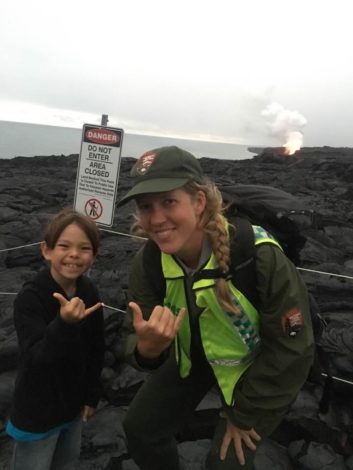
In this park ranger interview series, I'm speaking with park rangers across the United States about their job and how to encourage kids to love the outdoors. Today's post features Laura Dvorák, U.S. National Park Ranger at Hawai’i Volcanoes National Park, Eruption/Protection Division.
Is this the first National Park you've worked at?

This is the first park I have worked at. I have previously worked in a horticultural therapy setting, and in the fields of outdoor/sustainability/permaculture education.

Where did you grow up? In the country, a city, or a suburb?

The suburbs of northeastern New Jersey.

What did you love about the outdoors as a child?

I loved fresh air. I loved the spontaneity as well as the stability of animals and plants and natural elements. We didn’t camp often but when we did, I remember the excitement and curiosity at observing newts and geese and raccoons. We spent countless days on the beach in Wildwood, NJ. I appreciate the lack of agenda in the outdoors and the opportunity to just be present with the senses (including the sense of wonder). Photo Credit: Krystal Weir @krystalweirphotography

When did you know you wanted to work in outdoor education?

My first outdoors job was in the summer of 2000 (at the age of 19) at the Princeton Blairstown Center in northwestern New Jersey. We offered immersive leadership experiences for coming-of-age youth from disadvantaged urban communities. The woods and rivers were like a crucible in which to allow other distractions to fall away. I remember being assigned to blaze a perimeter trail around the 300+ acre property, and discovering carriage wheels, stone walls, and house foundations from the colonial era. It gave me an appreciation for the recent history of the region, a place where time seemed to stand still. I obtained my Master’s Degree in Geography and Leadership for Sustainability Education and while it has not always been the most straightforward or lucrative career path, it has been replete with fresh air, (mis)adventure, and experiences that have built character as well as a deepened desire to know the natural world.

Who encouraged you to pursue a career in outdoor education?

Many mentors over the years – human and non-human alike. Mostly I saw a need for it. I have worked in classrooms as well as in the outdoors. Experiential and discovery learning had a lasting impact. More than books, more than tests.

What is the most common question you get from park visitors?

They all want to know how they can get the closest possible to the lava. It is awe-inspiring and at once evokes a sense of danger and reverence. They are astonished that we, too, operate at the mercy of the volcano’s unpredictable actions. One day the ocean entry may be there. The next day it is not. One day the cliffside may fall into the sea. One day the surface lava may flow in crimson rivers, the next day it is a shriveled gray mass resembling elephant skin. We cannot control it, but we can maintain a sense of wonder while keeping visitors safe and natural resources from being disrespected or exploited.

How can parents raise kids to love the outdoors?

Lead by example. If a lot of your energy and attention goes into your phone and computer and TV, how can you expect your children to act any differently? Establish formative memories together in the outdoors. Offer opportunities for predominantly positive experiences. If a child is bitten by mosquitoes or sunburned, or anxious about spiders or big waves in the ocean, don’t let it deter them from finding something they DO love outdoors; even if it is reading a book. I loved reading as a child and would bring a stack of books to a fort or under a tree and just lose myself in other worlds, in my inner world. I suffered infections from spider and mosquito bites, as well as poison ivy and sunburn, but in the end I did not internalize the idea that I was supposed to be afraid of the outdoors. If you live in a city, get out into your parks. Open the windows. Plant seeds. Visit local resident birds and wildlife, and get to know them. Engage with the outdoors as though you were not a stranger to it, and your child will feel as though he/she belongs somewhere on this precious planet, a powerful investment in future stewards of the environment. Give them space to respect nature while giving them skills of self-sufficiency and protecting the environment. Solo time in the outdoors is very, very healing and powerful for personal development. Even just a few minutes per week or per day can have lasting effects benefiting both mental and physical health. Children these days are not exactly encouraged to spend solo time outdoors, with justifiable fears like getting lost or being abducted, and paramount distractions like video games (and homework). But even just choosing a little nook in the backyard, or a tree stump off a familiar hiking trail, could mean the difference between developing into a person who knows their place on the Earth and one who feels estranged (and therefore more likely to make decisions that are destructive of self and of the environment). A child can learn just as much about mathematics and science, as well as alliterations and metaphors from a forest as they can from a textbook. Learning does not have to stop at the threshold of a classroom or desk. And some of the most important learning that takes place is non-verbal in nature. It cannot be rationalized or quantified.
Many thanks to Laura for giving us her perspective on raising a generation to love the outdoors! Follow along with our monthly conservationist series here on the Hike it Baby blog!

Community tags

This content has 0 tags that match your profile.

Young Explorers (Walker +)

Comments

To view comments or leave a comment, login or sign up.

Related Content

0
5 Tips for Trail Cleanup Safety
Trail cleanups can be a powerful way for families to give back and connect with nature at the same time. With little ones in tow, safety and simplicity are key. Whether joining a group event or picking up trash on your usual stroll, this guide offers practical tips to help make your next cleanup effort safe, age-appropriate, and meaningful for everyone involved. Winters can be hard on trails. Many will need both cleanup and maintenance come springtime. You can contact your local or state park system to see if they have anything planned, or you can plan your own trail cleanup hike with your Hike it Baby branch! Hike it Baby offers lots of information on organizing a trail cleanup, and safety is a consideration when participating in a trail cleanup. Some of these things may seem like common sense, but it’s always nice to double check your preparedness whenever you try something new (or for the first time in a while). 5 Tips for Trail Cleanup Safety 1. Bring proper cleanup supplies Certain supplies will come in handy during a trail cleanup. This would include gloves, trash grabbers and bags. It’s a good idea to have the littles carry the trash bag instead of picking up trash. They may not know what they should and shouldn’t touch. 2. Work in pairs or groups Sticking together and staying in communication with the organizer are very important. Make sure you have a charged cell phone or walkie-talkie with you. A compass could also come in handy if you're off the beaten path. Make sure someone knows exactly what area your group will be working in. Check in often with the organizer and stay close to your partner or group. Or, if you're hosting the hike, help the group stay together and communicate the meet up locations and times. 3. Bring your normal safety supplies All normal hiking injuries can occur on a trail cleanup. In fact, after winter, the trail will likely be in worse shape than usual, so be prepared. Make sure you pack your typical first aid kit, plus plenty of water and snacks. 4. Give the kiddos simple tasks The concept of trail cleanup is super important to share with our kids beginning at a young age as it teaches them to be stewards for our trails and parks. It’s even better to reinforce as they get older. That being said, not every trail cleanup is organized with young children in mind. If attending a hike organized by another group or parks department, speak to the cleanup organizer before deciding whether or not you will bring young children. Make sure there will be tasks suitable for their age and ability. With supervision and proper gloves and grabbers, tiny people are great at holding trash bags, spying trash, and they love to use trash grabbers! Older kids can also be great to pair with younger kids. If hosting your own hike, make sure you communicate what supplies to bring and provide safety tips during Welcome Circle. 5. Use caution Don't ever touch anything sharp or lift anything too heavy. While you will typically feel totally awesome after participating in a trail cleanup, you might not if you cut yourself and get an infection. After winter, there could be trees or large branches across the trail. Don’t try to be the hero and lift something too heavy on your own. Even professional bodybuilders use a spotter to lift. Bring a notepad with you and document anything you can’t handle. Then give this list to the trail cleanup organizer so that the proper crew can address it. (Or, if you're hosting, contact the parks department with the information.) For toddlers and little kids, have them spot the trash ("I spy!") instead of picking it up. This will ensure they aren't picking up anything dangerous or unsanitary. What are your safety tips for trail cleanup? Have a question about safety while participating in a trail cleanup? Leave a comment or a question below! Read More: 11 Tips for Safety on Trail 3 Trail Safety Tips You Must Know Photos by Vong Hamilton. Hike it Baby hikes are hosted by volunteers who have no professional training and are not experts to guide families on hikes. They are people who want to raise a generation to love the outdoors and they accomplish this by facilitating outings for all to join. Our tips are gathered from collective experience. As with any physical activity, please be sure to check with your healthcare provider and other experts when hiking with your children. About OutGrown OutGrown is a national nonprofit working to ensure that every family, especially those with babies and young children, can experience the benefits of time outside. Since our grassroots beginning in 2013, we have supported more than 300,000 families with the help of thousands of volunteers across the country. We believe nature belongs to all of us from the very beginning. That means creating opportunities, removing barriers, and supporting families in finding their way outdoors, whether that starts with a stroller walk, a community outing, or a quiet moment under the sky. You can learn more and explore our programs at WeAreOutGrown.org. Editor’s Note Thank you for reading. At OutGrown, we believe content should offer more than information. It should create a connection, support real-life caregiving, and reflect how families grow together through nature. Everything we share is made with care by our team and volunteer community. If this piece inspired you or helped you feel more confident in your outdoor journey, we invite you to support our work by donating today. Your contributions help us keep resources free and accessible to all families. Please remember that the experiences and tips shared in this article are for general information only. They are not a substitute for professional medical, mental health, or safety advice. Always consult with a qualified provider if you have specific concerns or questions. We are glad you are here. We are growing something meaningful together.
0
Parks Defined: What does "park" mean to you?
Whether it's an urban playground, a nearby greenspace or a national, state or other agency-run park, there are plenty of options to enjoy for the whole family. This article was updated on May 31, 2024. What does the word "park" mean to you? City parks are familiar to many of us—from tiny neighborhood playgrounds to larger areas of trees, ponds, wildlife and trails. But there are many other types of parks, like state and national parks.    You Have a Big Backyard No matter where you live, how small your yard at home, or how urban your neighborhood—you have a very big backyard. It’s called “public land” and it belongs to all citizens of the United States. It includes vast wilderness areas, lakes, rivers and forests. Having access to such great places to play is a unique privilege. But All Parks are Not Created Equal In my some places there may be several nearby public lands with similar names but run by different agencies. For example: Ashford County Park | Nisqually Mashel State Park | Gifford Pinchot National Forest | Mount Rainier National Park. These four different agencies manage these four parks (and forests): one at the county level, one at the state level, and two at the federal level. The name is often your first clue to the type of park you’re heading into and what sorts of activities are allowed there.  This varies quite a bit because ... It’s All About the Mission The agency's mission dictates how land can be used by the public. For example, the National Park Service's mission is “to preserve unimpaired the natural and cultural resources.” The US Fish and Wildlife Service must “protect and enhance fish, wildlife, plants, and their habitats for the continuing benefit of the American people.” State park missions often emphasize providing recreation opportunities. What's Allowed and What's Not? First, find out the rules and regulations before you go because they can vary greatly! Rules about whether or not dogs, bicycles or strollers are allowed on trails may impact hikers. Camping may be allowed anywhere, or only in designated areas.  Not sure where to look? Start with the park's website, where regulations are almost always posted. Additionally, entrance stations may hand out literature, or signs may be posted at trailheads. You can also stop at visitor centers for information. Playing by the rules protects you and the park you're visiting. Buddy Bison and Kids to Parks Day are part of National Park Trust's mission to get kids outside! Find the Right Park For You Determine if a particular type of park is going to give you the experience you’re looking for before you go. If you’re envisioning a great family hike but can’t dream of leaving the dog behind, then head to a trail in a national forest instead of a national park, since dogs are prohibited on most national park trails. If you’re looking for a purist backpacking experience with no bikes or pets and very few people, then a wilderness area might be a good fit, as they have the strictest rules on types of use. Looking to canoe or kayak with the family? A national recreation area may have the perfect lake for you. Get Outside! Finally, wherever you decide to go, get out there and enjoy your parks! Need more info? Check out these websites: State Parks:  http://www.stateparks.org/find-a-park/ National Parks:  www.nps.gov National Forests:  www.usda/gov/usfs Bureau of Land Management: www.blm.gov US Fish & Wildlife Service:  www.usfs.gov Here's a little more about OutGrown: We're a national, 501c3 nonprofit with over a decade of experience helping families get outside with their babies and young children. We believe it is critical to include and center families from birth because it is a crucial developmental time for both the infant and the parent, where we can create a life-long, multi-generational impact. We know that we protect what we love and we're helping families build a loving connection with the outdoors so they can value and protect it for generations to come. As a community-driven organization, we have been working with indigenous, Latine, BIPOC, immigrant & refugee, and rural families to co-design multilingual and culturally relevant solutions in our programming. Since its grassroots inception in 2013, OutGrown is a growing community of 280,000 families and over 300 volunteers. More information on all of our programs can be found at WeAreOutGrown.org  EDITORS NOTE: We hope you enjoyed reading this article from OutGrown. We’re working hard to provide our community with content and resources that inform, inspire, and entertain you. But content is not free. It’s built on the hard work and dedication of writers, editors, and volunteers. We make an investment in developing premium content to make it easier for families with young children to connect with nature and each other. We do not ask this lightly, but if you can, please make a contribution and help us extend our reach.