
Leave No Trace Part 2- “Choose The Right Path”

This is Part Two of our Leave No Trace Series: Travel and Camp on Durable Surfaces
I live in Boulder, Colorado. Weather one day could be 70 degrees and 15 inches of snow the next. This makes for some pretty inconsistent trail conditions. I was just recently on a hike with some friends and their kids. The trail was a mix of packed snow and ice, mud pits and dry cracked dirt. I had my hiking boots on but also had my shoe spikes in my pack since sliding on ice and twisting my ankle is one of my specialties.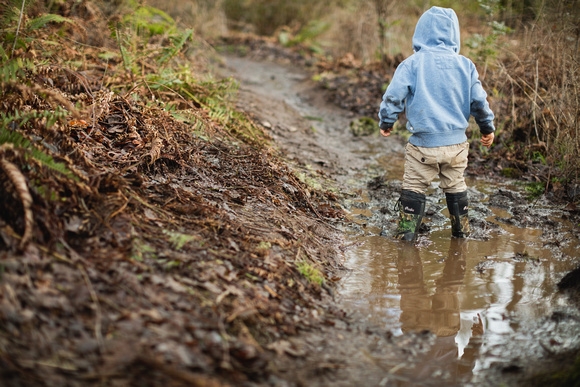 As I was hiking along with my non-walking son in my pack, I was watching the 5 year old in front of the line leading the way. He was delightfully dashing around the puddles and mud, leaping over snow patches and walking around them if they are too big to jump over. His parents were following in pretty much the same fashion. It seemed like both age groups did not want to get dirty.
I get it. Mud is annoying, dirty and a pain to clean. BUT it is also pretty fun. And if it means walking through it to stay on the trail, you will be doing the great outdoors a lot of good.
Choosing the right path sometimes means walking through a puddle, mud, ice, or snow. This is why preparing for your hike by wearing the right footwear is so important.
As I was hiking along with my non-walking son in my pack, I was watching the 5 year old in front of the line leading the way. He was delightfully dashing around the puddles and mud, leaping over snow patches and walking around them if they are too big to jump over. His parents were following in pretty much the same fashion. It seemed like both age groups did not want to get dirty.
I get it. Mud is annoying, dirty and a pain to clean. BUT it is also pretty fun. And if it means walking through it to stay on the trail, you will be doing the great outdoors a lot of good.
Choosing the right path sometimes means walking through a puddle, mud, ice, or snow. This is why preparing for your hike by wearing the right footwear is so important.
 Yelena Hughes resides in Boulder, CO and spends her time adventuring with her son, Forrest, husband, Ryan and her two super dogs Georgia and Stella. When she gets a spare moment, she practices yoga and works on her business where she takes teen girls on adventure travel trips around the world. She is also a science teacher and loves talking about all things science. Which is pretty much everything in the universe!
I live in Boulder, Colorado. Weather one day could be 70 degrees and 15 inches of snow the next. This makes for some pretty inconsistent trail conditions. I was just recently on a hike with some friends and their kids. The trail was a mix of packed snow and ice, mud pits and dry cracked dirt. I had my hiking boots on but also had my shoe spikes in my pack since sliding on ice and twisting my ankle is one of my specialties.
As I was hiking along with my non-walking son in my pack, I was watching the 5 year old in front of the line leading the way. He was delightfully dashing around the puddles and mud, leaping over snow patches and walking around them if they are too big to jump over. His parents were following in pretty much the same fashion. It seemed like both age groups did not want to get dirty.
I get it. Mud is annoying, dirty and a pain to clean. BUT it is also pretty fun. And if it means walking through it to stay on the trail, you will be doing the great outdoors a lot of good.
Choosing the right path sometimes means walking through a puddle, mud, ice, or snow. This is why preparing for your hike by wearing the right footwear is so important.
Tips for choosing the right path (traveling on durable surfaces):
- Before your hike sit down with your kiddo, take a moment to actually look at the bottom of those fancy hiking shoes. They are rugged, burly and look like the tires of a major earth moving machine! They are MADE for mud, water, snow and slush! So it’s OK to use them!
- On the trail, stop and observe it. The trail may have telltale signs of other people's footprints or even animal tracks. This is a great teachable moment to notice who and what uses the trail. Also observe if the vegetation around the trail is damaged. You might see this around the edges of a muddy patch. Notice this impact and point out to you little one the impact that going around the yucky park will have on the nature around it.
- No short cuts. This can be hard for a busy kiddo. Just think if everyone took a shortcut you might find a maze of multiple trails and a lot of harmed habitat, not to mention a lot of confused hikers. If you think there is a safety issue with an especially muddy trail, or a trail with a puddle that is potentially too deep, you might have to change your plans. Leave No Trace recommends hiking in the early morning or evenings when temps are cooler and mud hardens. Another option is to choose a south facing trial after a storm.
- When you need to take a break, it’s OK to travel off trail if your group spreads out to lessen the impact. This can be a great time to walk side by side instead of the single file line that a lot of trails require. Always step off the trail for breaks in order to clear it for other travelers. This goes for seeking a bathroom spot as well.
Here are some quick tips for having a teachable moment with your kiddo and keeping clean afterwards:
- Observe the bottoms of your shoes and notice how rugged they are!
- Keep track of the tracks you see! Human and animal. This will help kids focus on staying on the trail. But don’t forget to look up too.
- Keep a trash bag open and ready in your car to put muddy boots in if you don’t want them on the floor of your car. This also means you might want clean shoes to slip on for the ride home.
- After your hike, have your kids mark on the map any cool details they saw from the trail. You can also take photos of tracks and look them up when you get home.
Photo Credit: Tais Kulish
 Yelena Hughes resides in Boulder, CO and spends her time adventuring with her son, Forrest, husband, Ryan and her two super dogs Georgia and Stella. When she gets a spare moment, she practices yoga and works on her business where she takes teen girls on adventure travel trips around the world. She is also a science teacher and loves talking about all things science. Which is pretty much everything in the universe!
Related Content



Comments